
The Bible Under the Microscope (III)
Mauro Biglino: Conference May 2019 (II)


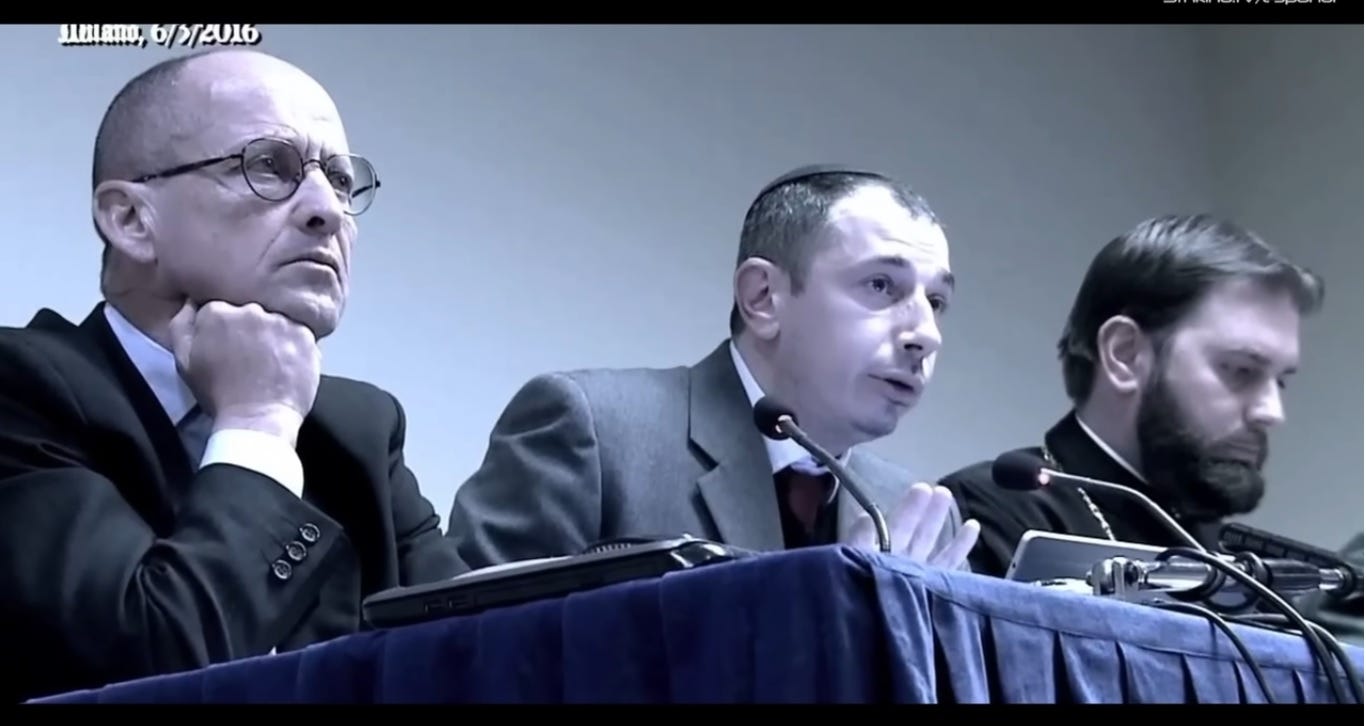
We continue with Professor Biglino's lecture. In this chapter, various aspects related to the meeting held on March 6, 2019, in Milan are addressed. On that occasion, Mauro participated alongside several theologians and other speakers in an event where journalists and the general public posed questions to the participants. Among the topics discussed, there is also a prominent discussion about original sin.
Conference:
On March 6th in Milan, we had a meeting with several theologians. The full transcript is available online. There were five of us: a priest who teaches theology at the Faculty of Theology of Northern Italy, the chief rabbi of the Jewish community of Turin—rabbis are the most officially accredited to study and explain the Bible—an Orthodox archbishop, and one of the most important Italian biblical scholars, a Waldensian, Dr. Garrone, one of the authors of the Dictionary of Biblical Hebrew and Aramaic of the British Bible Society, the gentleman who was sitting to my left. We addressed fundamental topics. First, four identical questions for everyone, with five minutes to answer. Then, questions from the public.
The first question was: Do we have certainty about the existence of God?
The chief rabbi said: "It is not possible, at least in certain aspects, to speak of an evidence regarding our knowledge of God. Therefore, believing in God would be an axiom. We have no evidence."
The Waldensian biblical scholar said: "I cannot demonstrate what the source of that knowledge is. I cannot demonstrate it, but if you wish, then the certainty that the voice of God resonates in that book appears." If you wish, then the certainty that that book is the voice of God appears. And he added: "My fundamentalist cousins—that is, the Catholics—who think they are serving God by deifying the Scriptures, are practicing paper idolatry." Is that clear? Did you understand that well?
The Catholic theologian, who teaches theology, said: "I can say bluntly that it is necessary not to have certainty of God. Because if we have certainty of God, then that is not God." The debate could have ended there. For me, everything had already been said.
One of the organizers who arranged this debate took a year and a half to get these people to attend. We wanted qualified professionals, not just anyone, not those who attack me online and invent interpretations, exegetes, and who are so knowledgeable about the Bible. We wanted people with credentials, and we managed to bring together prominent specialists. And these were their answers: we have no certainty of God.
The second question was: Do we have certainty about the translations?
I already said at the beginning that to make the Bible say things it doesn't say, the category of allegory and metaphor was introduced. And I say, okay. Now, if allegory and metaphor are the categories that are going to be used, let's go to the first verse of Genesis, where it says: "In the beginning God created the heavens and the earth..." and this is clearly an allegory. That is, since those people didn't know, just as we don't know today, how the Universe originated, they invented the allegory that someone created it. "Oh, no, no... that's true, that's read literally." Wait a minute, who is it that establishes and decides which verse is read literally and which allegorically? Tell me what the law is, because if I am a believer and I want to read the Bible, from the moment the Bible would be the book that God dictated to reach me, then tell me what the rule is. And the truth is that that rule does not exist. So it is they, when it suits them, who decide what should be read literally or allegorically.
So for the second question, the chief rabbi, Dr. Ariel Di Porto said: "the first verse of Genesis is very problematic because if you read the interpretations that have been given, you will find the opposite of everything. The indications that it should be read allegorically derive from rabbinical traditions." Again, someone appears who tells himself, this here must be read literally and this must be read allegorically.
The Waldensian biblical scholar said, at minute 48:39 of the debate: "Now I definitely have no doubts, the Bible should not be read allegorically, if we take 'allegory' in the technical sense, that is, as it has been used in the tradition of the Church. The Bible must be read as it is written." The Bible is not read allegorically. Fantastic! We agree, I've been saying this for 6 years, that I say "let's assume what is written is true and see what comes out of all this." So the allegory is finished.
If we all say this publicly, there would no longer be a need for conferences like this one. So we conclude that the Bible should not be read allegorically. And by the way, these things are not written here. If you take the book by Sergio Quinzio, the theologian who even cites Gershom Scholem, who is one of the most important Jewish theologians, thinkers, and kabbalists, etc., he says that whoever reads Genesis, also the Torah, that is, the first 5 books of the Old Testament, thinking to find the spiritual concept within is a victim of a colossal illusion. And that's true. It has nothing spiritual. Afterward, if the spiritual world exists, great, it exists. I have nothing to say about that. But the Bible doesn't talk about that. Period. After that, everyone will look for the spiritual world, talk to angels; I have nothing to say about that. I don't care about that. But don't come and tell me that the angels are the ones mentioned in the Bible, because about that I do have things to say.
Now, many theologians say that the Bible is not read in that way. But then, when they talk to people, they have to tell them that the Bible talks about eternity, that God is omnipotent, that creation existed, because otherwise, the whole circus would fall like a stone. It's not that the Bible would fall, but everything they built on top of it. So, finally, the Bible appears with its true morality, with its true essence, not as a book of fables, but as a book that tells concrete things.
And every so often someone comes to me and says: "You want to destroy the Bible." No!!, I don't want to destroy it, I'm defending it. I say: "look, this is written here." Afterward, everyone can believe what they want, but knowing that this is what is written.
Let's continue with the translations, the word “Almighty” was discussed, and the Orthodox archbishop said; "But, indeed, I think we all agree here, as Mauro said—I had intervened earlier—where the biblical text must be reread so many times. A text must be reread where the meaning of the original word is often lost, such as omnipotent, which has nothing to do with the original text." So, if it has nothing to do with it, they should remove the word!! It's very simple, it's done quickly. Go and delete it.
When Eternity was discussed, what we read at the beginning, the biblical scholar said: "It is true, from time to time there is a bit-too much of 'Christian pre-understanding' in the choice of words from certain bases, but it is understood that the author is a pious Christian and so we are knocking down an open door when we say that we must correct many errors or inaccuracies in our translations. All dictionaries, all the great dictionaries say that, including the theological dictionaries." ... a bit-too much of 'Christian pre-understanding'!! But if the door is open, we have to change this error here now, knowing it is an error. And if we know they are errors and we continue writing them, they are no longer errors, they are deliberate forgeries. Because when he says: "Do not translate as Eternity" he, the Waldensian biblical scholar, says that all dictionaries, including the theological ones, say "do not translate as eternity," do we want to remove the word eternity from the Bible or not? Because it is not there. And if it's not there, let's take it out. The problem is not to eliminate a concept, but to eliminate something that we know was artificially added. And the moment we know it was artificially put there, let's do something about it because we already know it is a forgery if it continues to be published. If someone pointed out an error like that to me in my books, they would lynch me. But I would correct it the next day. Instead, here, thousands of Bibles continue to be printed with "eternity," knowing that it is an error, since it does not exist.
And listen to what the Catholic theologian said: "In the Semitic world there is no philosophical-metaphysical concept of eternity or immortality. This concept of creation out of nothing is a vision that is completely foreign to the Semitic mentality." It's not there. And if it's not there... then it's not there.
So much so that, if you read the works of many other theologians, that is, they are translators, Jewish exegetes, all university professors at the Jewish university, both in the US and in Israel, they write in books like this one, which is a book from the Jewish Publication Society, where all rabbis, all university professors write, here it is written that the story of creation is nothing more than the story of a series of subdivisions in a certain situation, to try to put things in order. The rabbis, university professors, write it. Creation is not in the Bible, it does not exist, not even the metaphysical concept.
Do you know why Christianity exists? It exists because Greek philosophy existed, which was taken, especially Platonism and Neoplatonism, and forcibly inserted into the Bible, to make the Bible say things that the Bible doesn't say. If Greek philosophy had not existed, Christianity would not exist. Judaism would, because Judaism has nothing to do with Greek philosophy. Greek philosophy was the instrument thanks to which Christian religious thought was created, by forcibly inserting it into the Bible. If we change that, the Bible becomes what it is: a book in which a family told the story of its relationship with an individual, period. So much so that, a lot of the things I say, the Jews have known for a long time, as we will see later, when we talk about cloning, etc.
And then one says: But why don't they say it publicly? Well, because they have no reason to say it. Because Christianity took this book, which was, by the way, the account of the relationship between a family, not of the Jewish people, but of the family of the Israelites, because the other Jews were descendants of the same family of Abraham, and they were exterminated. So, attention, we are not talking about all Jews, but about the Israelites, the descendants of Jacob, who was later renamed Israel, of the relationship between this subject Yahweh and them, end of story. It's over. Thus, it was transformed into something it was not. And this Yahweh was transformed into the omniscient, transcendent, omnipotent, etc., etc., etc., god. And the Jews say: "So, first they stole our book and then they invented whatever they wanted. Now, you believe all that you invented; that's your problem. We have no reason to explain anything to you. We know what the Bible is."
When in January Pope Francis went, as he does periodically, to the synagogue in Rome and met with the chief rabbi of the Jewish community of Rome, Rabbi Riccardo di Segni, there were smiles, hugs, and kisses, but they don't agree on anything.
Rabbi Riccardo Di Segni said, and you can corroborate this because I think it's online: "We do not receive the Pope to talk about theology, because faith is not the object of negotiations or political debate." That is, as if he were saying, it's better not to talk about this. Because if they start talking, people will understand that they don't agree on anything. And if people understand that between the Roman Church and Judaism, who share the Bible, they don't agree on anything, people are going to start asking questions, because they are going to say: "How is it possible that they started with the same book and then...?" It's obvious, because for one of them the book is a certain very concrete thing, but for the others it was necessary to invent something equally precise, but precise from the point of view of their fantasy. And for that reason, they don't talk about these things at all, especially when they are in public. Because even when the Church says to the Jews "you are our elder brothers in the faith" and if I were Jewish I would say: 'No'. They say it anyway, not publicly, but... "I have nothing to do with your faith. You stole a book from me, I have nothing to do with the faith you built on that book, because that book talks about me, not about you. Not about you, it talks about us, about the family of the Israelites. These are promises for us, and if we fulfill our part of the pact, then he will fulfill his. But it has to do with us, not with the world of Christendom, which is an artificially constructed world. That's why they don't discuss theology, much less publicly, because otherwise people will realize it and people don't have to understand that we don't agree on anything.
And the debate continued and we arrived at a concept, and here we understood each other a little better, because it had to do specifically with Christianity. Now, we know that, in short, the doctrine says: we are sinners, because our ancestors committed sin, the one considered original sin. We are born stained by original sin, which is the sin that brought death and suffering to the world and that, therefore, we must live with the hope that through the mediator we can be reconciled with Him. This is possible through the sending of his Son, who was sent here to be tortured, killed, and then resurrected. Thus, we can have the hope of accessing the eternal life we had before. But eternity, in the Bible, is not there.
When original sin was discussed, the question was first answered by the chief rabbi: "Here it becomes difficult to talk because I don't want to offend anyone's sensibilities"... since, for Jews, original sin does not exist, because it is not in the Bible and that is why he rightly says it is difficult to talk about this because he didn't want to offend the Christians who believe in original sin; it was uncomfortable, so that's why he says it. The concept of original sin began to be introduced by the apostle Paul in the Letter to the Romans, where he says that, because of one man—Adam—evil and suffering came into the world [Romans 5:12] and that thanks to this other man, who would be Jesus Christ, hope is restored. So the concept of original sin begins to be elaborated by Paul and then it will be taken up by Saint Augustine of Hippo [4th and 5th centuries AD], and from there the great fable began.
You will already know that original sin is that of the disobedience of Adam and Eve, so the Waldensian biblical scholar said: "Now, between Genesis 3 and Romans 5, the letter to the Romans written by Paul, in which the apostle Paul says that, through one man, death entered the world, there are no coincidences, and rather, one, upon reading Paul, can ask where he got that idea?" And I agree with him, so let's stop this farce, let's start asking where he got that idea, since it's not in the Bible.
The Catholic said: "The concept of original sin must be separated from the classic concept. That is, that if the parents have sinned, the children suffer the consequences. A situation of this kind, from my point of view, in the New Testament, is widely contradictory, but also unfortunately it is widely used by theology." That is, should we continue? Everything has already been said. The word "eternity" is not there, "Almighty" is not there, "immortality" is not there, "creation out of nothing" is not there, "original sin" is not there. And what are we talking about then? And that is what I have been saying for six years, about a common and ordinary history book, one of the many history books that humanity wrote throughout its history.
And if original sin is not there, here in the auditorium is Laura Fezia, who wrote a very good book which is "Marian Apparitions: The Great Fraud," and she is also preparing another equally controversial, or even more so. In 1854, Pope Pius IX proclaimed the dogma of the Immaculate Conception, which, for many Christians, means that the Virgin Mary conceived Jesus without the "messiness" of sex. The Immaculate Conception means that he is the only human being in all of history to have been born without the stain of sin. But if original sin does not exist, all of us were born without that stain. So, therefore, that dogma is a dogma that tomorrow morning will be false, or in the best of hypotheses, a dogma that, over time, will disappear, because all of us were born "immaculate," because original sin does not exist.
In 1858, in Lourdes, Bernadette Soubirous, a female figure appeared to her whom she called "Aquero," which in the Pyrenean dialect means "that one." She always called her "That one." That later became the Virgin, when the church, as Laura explains very well, when the church took ownership of all this, and she said four years after the dogma, "I am the Immaculate Conception." Now, if it was the Virgin, did she know what she was talking about, knowing that original sin does not exist? And if it wasn't the Virgin, could it be that they made her say what she didn't say, because it served the Church, that someone endorsed that dogma, which dogmatized nothing?
Jerusalem Bible, I am keeping the pact, okay? None of the translations are mine. So whoever disagrees with me, because there may be some among you, let them argue among themselves, them, that is, the wise ones, and then they can tell us ignorant ones what the conclusion is. But let them argue among themselves if they don't agree. That is, let them argue with those who wrote the dictionaries; let them argue it with the Jerusalem Bible, which says that "omnipotent" does not exist; let them argue among themselves. We can wait, no problem. So if they don't agree, let them figure it out among themselves. And I'm not even talking about using a single one of my translations. I'm telling you that the answer to everything they say is already written in the Bible.
Original sin, Genesis 3. You know, when Adam and Eve disobeyed. By the way, this is perfect for talking about free will. The first time Adam and Eve make a decision on their own, and you know what happened. So this is free will, that is, we make you free to decide, but if you don't do what we say...? Is that free will? As far as I'm concerned, no, excuse me. All the dictators in the world say: "If you don't do what I say...!!" And if you read the Bible, you will see that everything revolves around this: if you do what I tell you, I will help you; and if you don't do what I say, I will annihilate you. And it's here, in this life, not in the afterlife; here he exterminated them. This is the free will of the biblical God, who, luckily, is not God. Obviously, he was a simple ruler, like all the others.
Now then, to summarize, these two individuals make this autonomous decision, which among other things means becoming autonomous from the point of view of reproduction. It is very probable that Eve, as it is written even in rabbinical literature, had sexual intercourse with one of them. It is very probable that Cain is the son of one of them; on the other hand, Abel is the son of the sexual encounter between Adam and Eve. And later, regarding this, I am going to read you something curious that happened with Adam when Eve was presented to him.
Now then, let's say, the disobedience, Jerusalem Bible. Here it is not about a punishment for man because of a committed fault, but rather a preventive measure. So when Adam and Eve make this autonomous decision, the Elohim say—and you can read it in the Bible—: "Now, the Adam has become like one of us." That is what is written. And I'll add this, "now, let him not have access to the tree of life." So for this, leave here. It is a preventive measure, because the Elohim were terrified that the Adam, who already understood certain things, would have access to the tree of life, where certain other things are done, because they could become powerful and very dangerous for them. It is a preventive action. So it is not that they are expelled from paradise as a punishment; they are expelled to prevent them from becoming powerful and then turning against them. But it doesn't end there. In the Jerusalem Bible it says: "Regarding the dogma of original sin—listen to this carefully, page 25, 2013 edition—one should not look here for everything that was said later, whether it is about biblical reinterpretations, for example, Paul's in Romans 5, or the dogmatic formulations of the church." You should not look for them here, because they are not there.
There is no word that means God, nor one for eternity, nor Almighty, nor creation, nor immortality, original sin does not exist, is there a need to say anything else? And I am not talking about any particular translation, I am reading what they write. And I have been saying for a long time that I do the work of an idiot, the most stupid job in the world, I read what is written. So, none of these things I mentioned exist.
Now, reaching this point, the obligatory question is, if there was no creation... -the journalist asks-
According to the biblical reading, can one then speak of a creation?
The Catholic theologian says: "Adam was...-ellipsis- was made." That is something quite different. The journalist says: "So, are you agreeing with Mauro Biglino on that?": "No, I meant that he was... with something else, but that he came from something if we want to maintain the allusion, a possible allusion that man is... was made from something else. Yes, that he was made from something else." It seems to me that he couldn't continue talking. That is, man was not created, he was made from something else, exactly as the Bible says. That is, we are genetically modified organisms.
And when they made Eve, the Bible says one thing clearly about it, whoever has the Bible, look up Genesis 2, verse 23. The Bible says that man was created in the Terrestrial Paradise, well for starters, man was not created. The Bible doesn't even say that it happened in paradise. What it says is that the Elohim took the Adam and put him in the Gan Eden. So, the Adam was made somewhere else and, afterward, they took him to that place. And they only took the males, the Adam, and that is why in the Bible it appears with the article "the," that is, as "the Adam," because it was not the name of one of them, but rather it indicates a species [group of people].
And they took the males because, the Bible says, so that he would guard and work that place. Afterward, the Bible says that, after a while, God realizes—because it seems he didn't know—that the company of animals was not enough for the Adam. Ideas come late to God, he couldn't foresee it. And so he decides to make the woman for him, and to make the woman, as the geneticists with whom I am collaborating and who are writing in the book, they used a cloning protocol that is the same as the one we have today, except for an intermediate step that is not mentioned in the Bible. We can talk about that later, if you want.
So, they put the Adam in a very deep induced sleep, they take a thing from a lateral curved part, which is translated as a rib. They close the flesh where they made the extraction and, with what they extracted, they created the woman. They present her to the Adam. The Bible, which is a synthesis of much older stories in which this process is described in much more detail, it is said that they decided to make the woman and, so, they made her. I went to eat at the house of Laura Fezia, the writer I was talking about earlier, and I said: "Laura, this time, the pasta turned out just right," which means that all the other times it didn't. Okay, it's an example, it's not true, it was to make an analogy. The Elohim present the woman to the Adam and he says, translation from the Christian Family Bible: "Now, the Adam says, this time, it is bone of my bones and flesh of my flesh." "Now, this time." In Hebrew it is written with the definite article: "This is the time." And the Jews who translate it into English translate it as "finally". Finally, this one I have now is the right one. That is: all the ones they gave me before, no. And in rabbinic literature it is written that he rejected other females. And here a wordplay appears that is magnificent. Be careful: this is written in the Bible you have at home, not in my translation, you just have to read it paying a little attention, because it is a fascinating book, it is a book full of incredible things. "This time it is bone of my bones and flesh of my flesh." The others... I didn't like them. And I imagine God saying: "Well, finally it's good." And so, for that reason, she will be called "Isha"—woman—. This doesn't fit in Italian, so the two Hebrew words are written here. So she will be called Isha (אִשָּׁה), because from the Ish (אִישׁ) she was taken.
[Note: in Hebrew it is understood much better than in later translations, Isha is the feminine of Ish, they just add the -a at the end. The Greek Bible is written γυνή (gynē), which means "woman." And in the Latin Bible, mulier for woman.]
And this, in Hebrew, can be understood perfectly: Ish means male individual, and Isha, is the union of the feminine ending with the masculine Ish. So she came out of an Ish, therefore she is an Isha. It's like saying, she came out of a man, so she is a man-woman. [In English it would be something like from the man comes the man-ess].
So, it says "this time, they finally made her from me, this one now." Here it says it, and I continue with the pact. And I clarify again, you just have to read it, I repeat, we all have the intelligence to understand it, all, all, all equally. You just have to read it with a little interest, with a little attention, if possible, freeing yourself from those filters that have been put in place before, ..."this time," that means that there were other times that no, so there can be no doubt about this. No doubt; the other times, no.
So, Adam was manufactured, there is no Almighty, there is no eternity, there is no original sin... In the coming year, 2020, the Church, they will be doing it partially, is going to abandon the Old Testament, because they can no longer defend it. In 2008, the Congregation for Worship of the Vatican issued a circular—which you can find online, it's no secret—sent to bishops and priests, telling them not to use the name Yahweh anymore in the liturgy because it is not Christian. In 2008, and that is correct. And gradually, as time goes by, they have known it for years now. What happens is that, due to the current forms of communication, everything is going viral and they can no longer control it as they did before, until the late 50s or 60s. So, for that reason, the Old Testament will be gradually abandoned, because they can no longer sustain it. Obviously, because what it says there is very evident. So after that, everything will focus on the New Testament. The problem is that, since the New Testament exists, or rather, that character there, the critical figure, exists as the Son of God the Father, who is the god of the Old Testament, and he exists because he was sent to repair the mortal damage caused by original sin, but if in the Old Testament there is no God the Father, there is no original sin... then Jesus Christ? That is, it's useless to deny it, if the other doesn't exist, this doesn't exist. You can't say "Well, let's abandon that and focus on this." Let's focus on this if people continue without thinking. But if they thought, they couldn't even focus on this.
Which does not mean that what is written there, that is, what Joshua ben Yosef says, we give him the name Jesus, but we should call him Joshua, as I call him in my book, because his name was Joshua, like all the others. But if we call him Jesus, at least it seems as if he were the only one. But no, his name was Joshua and that's it. Jesus is the Latinization, but we call all the others Joshua and him we particularly call Jesus. Well, no, his name was Joshua like all the others.
So, if this Joshua existed, I would say that I am among those who think that he may have existed, but there is no historical proof, let the record show. That's why I say that I am among those who think he may have existed, because even the so-called Roman authors who talk about that group do not talk about him, they talk about the Christians, that is, about a sect that had a leader they called the Christ. But when Tacitus talks about this sect, he calls it superstition, which means that he is the first to think that it did not exist, because otherwise he would not have defined it as superstition. Therefore, there is no historical proof. But I am among those who tend to think that this Jewish, messianic Jewish, anti-Roman rabbi did exist. Afterward, on top of that, the well-known Christic figure was built, thanks to Greek Platonic and Neoplatonic thought. And to build the Christic figure, they connected it with a God the Father from the Old Testament where he is not mentioned, and they gave him as justification original sin, which does not exist. Therefore, the Christic figure has no reason to be.
In the book I wrote for Mondadori, which I told you at the beginning that I had done a parallel analysis, here in this book "The Bible does not talk about God," there is the first part; in the other book, which came out a week ago and which tonight we already have here finished, or at least all the copies that Mondadori sent me are finished, I used the same technique and did a parallel analysis between the Old Testament and the Greek texts. Mainly, I did it with Homer to show how they tell exactly the same story. That is, they talk about exactly the same individuals whom the Bible calls Elohim and whom the Greek texts call Theoi, and whom in India they call the Devas, and whom in America, they called the Viracochas. But they are always the same; they always have the same physical characteristics, the same attitudes, the same neurophysiological needs, they mobilize in the same way, they use the same technology, etc., etc., etc. Among other things, this book has become a bestseller, after they had to do many more reprints, something I didn't know. So there I started what I later continued in the other book. I repeat: it was published a few days ago, precisely to show how all ancient peoples, in reality, told the same story.
And if the same methodology—that is, the same exegetical and philological category that was applied to the Bible—were applied to the Iliad and the Odyssey, we could create Homeric monotheism. But, fortunately, it never occurred to a theologian to do something like that, because otherwise we would now be discussing Homeric theology. But luckily that didn't occur to them, so we limit ourselves to talking about biblical theology. But the stories are the same.
The interesting thing is that, if we analyze a topic that no one currently talks about, we must place ourselves in the context after the Council of Nicaea. At that time, there originally existed more than forty or fifty different forms of Christianity, each with its own teachings. It was then that Constantine summoned several representatives to Nicaea and told them: "Now you are going to leave here with only one Christianity." We will throw all the others in the trash and make them disappear. That is, you define one truth, I don't care which one, you choose, and we are going to declare all the others heretical and we are going to make them disappear.
By vote, they chose the one we believe now, that is, the one that is taught. And if another had been chosen in the vote, now we would believe in something else, but they chose this one. After which, everything that the first Christians did and said, obviously, was decided to be made to disappear completely. Luckily, books were written like, for example, those of Celsus, this was in the second century after Christ. Celsus was later declared one of the heretics. And also, for example, the writings of Justin Martyr, who, on the contrary, was declared a saint and is one of the fathers of the Church.
Now, listen to what Celsus says in his book called The True Discourse [Λόγος Ἀληθής, Logos Alēthēs], in the fifth chapter, we are in the second century AD, so he talks about the various beliefs of Christians. He says: "Well, let's leave out all the points that could be refuted about the one they call their master and consider him an authentic messenger. Now, was he the first and only one to come, or did some other come before him? If they try," -he's talking about Christians- "if they try to affirm that he is the only one, they can be caught in a blatant lie and contradiction, because they flatly affirm that others also came, in a number of 60 or 70 at a time." Did you understand?
And they also say: "that one came to his own tomb, or according to another version, two, and they told the women that he had resurrected”. The Son of God, it seems, was not capable of opening the tomb alone and needed others to move the stone. This is very clear, it says so in the gospels. Another of these messengers presented himself to the carpenter when Mary became pregnant and another one, to make them flee to Egypt. He is very far from being the only one who is said to have come to visit the human race. Second century AD. Christians said that these subjects came in groups of 60 and also 70 at a time. That is, all this was made to disappear because they chose the truth that says that this is the only son of God, and that is what we have to believe. But the first Christians did not believe that.
Justin Martyr, father of the Church, Saint, in his book Apology of Christianity, let's say he was a contemporary of Celsus, wrote to the emperor Antoninus Pius, to tell him: "But why do you persecute us, Christians? Why?" And listen to what he says: "Ours—that is, the one we believe in—is like yours. You know, in fact, the number of sons of Zeus that are talked about in your Scriptures and that are like ours. Hermes, who is the interpreter of the Logos, Asclepius, who healed Heracles. Afterward, someone will try to reproach the fact that he was crucified, although this is also something common among the sons of Zeus that I named at the beginning. Then, the fact that we say he was born of a virgin, although this is also something common for you with the story of Perseus. When we affirm that he healed the lame and the paralyzed, all this is the same as what your Asclepius did.”
That is, the Father of the Church, Saint, says: But why do you persecute us? Because we follow one who is exactly the same as those you follow? There is no difference, and this is evident. And a Father of the Church says it: Ours is like yours; it is the same, there is no difference. Do you understand?
Then the Council of Nicaea arrives, then the one in Constantinople, and from there, we have the Nicene-Constantinopolitan Creed, the one that says "I believe in God the Father Almighty, Creator....", a whole thing that they invented there, because before that, it did not exist.
We also have the beautiful story of Mary, who is visited by Gabriel. Now then, Gabriel is a word in Hebrew that is not a name, but a functional term, it is not a proper name, but a term that indicates one who exercises power on behalf of an EL. El is the singular of the word Elohim, indicating the powerful ones, that is, those who have control. So, in Hebrew, the word Gabriel [גַּבְרִיאֵל], comes from Gever (which means "the man" or "strong") plus the word EL (אֵל). The transformation of this word into Gabriel is done by changing the length of the vowels. Therefore, Gabriel is not a name in itself, but a term that indicates a powerful one, a representative of a powerful one.
Therefore, a Gabriel meets Mary and she becomes pregnant without having been with a man. In the Old Testament, it is told many times that these beings or characters visited the women of the Abrahamic families and, after the visit, they became pregnant. This story is constantly repeated in the Old Testament.
But pay attention: in contemporary texts, that is, parallel to the gospels, it is related for example that Joseph was afraid that Mary had been deceived by someone who was impersonating another. Now, this that I tell in the canonical gospels was obviously erased, since Joseph was supposed to be a man who accepted the will of God, and it was not like that. He thought and said: "But if it was like that, she must be stoned," and a series of problems were presented to him because he feared that someone had been impersonating another. Therefore, the story is different from the one they have always told us.
For example, in the story in which a Gabriel presents himself to Daniel [Daniel 9:21], you know, the prophet, and something curious happened. When Daniel sees him arrive, he says: "I saw an Ish arrive," as I said at the beginning, "I saw a male character arrive." And in the Bible you have at home it is written that he arrived flying quickly. In Hebrew, in the Hebrew dictionary, and in etymology dictionaries, this is an Italian dictionary, this is an English etymology dictionary, where that same verse is cited, they translate exactly, so you can see that it's not me who translates it like that, they translate exactly what it says in Hebrew: "he arrived very tired."
[Note: The root of מְעֻף is עוּף (uf), which can also mean weariness, fatigue].
In the Bible you have at home it is written "he arrived flying quickly." Why? The reason is that, since Gabriel is considered an angel, and angels can arrive flying quickly, it is said that he arrived flying quickly. But, in reality, Gabriel is not an angel, so he should arrive tired. That is what is written, it says so here. I'm not showing you my translation and I'm keeping my commitment, it's here, here is what the dictionaries say so you can see it as many times as you want, and they are compared with the photocopies of the pages.
So an Ish, a male individual, visits and she becomes pregnant without having known an Adam, that is, without having known one belonging to the species of the Adams. So it is likely that the Holy Spirit is the one who entered where he has to enter. [Laughter].
The Jesuit Jean Daniélou, a French academic, theologian, professor at the Catholic Institute of Paris, led a study on the figure of Gabriel and on the figure of the Holy Spirit. As you know, in the Gospel it is written that the Holy Spirit covered the Virgin with his shadow and she became pregnant. Well, he led a complete study; here he simplified it to say that the Holy Spirit is nothing more than the Christian transposition of the Jewish story of Gabriel. Jesuit and academic from France, professor at the Catholic Institute of Paris, explains that the Holy Spirit is the transposition, in Christian terms, of the figure of Gabriel. So that, covering the Virgin, was Gabriel and that is what Christians call the Holy Spirit.
When Gabriel goes to visit the Virgin, in Greek he says "Χαῖρε, κεχαριτωμένη", "Rejoice, full of grace." κεχαριτωμένη is an adjective and the middle passive perfect form of the verb χαριτόω "(kharitóō)," which means "to become pleasant," but in the physical context, "pleasant," that is, "beautiful."
[Note: κεχαριτωμένη does not explicitly carry the word "spiritual." The verb χαριτόω implies being graced, beautified].
So his greeting could have been: "Rejoice, you who have become beautiful!" Because that is the literal meaning of the verb χαριτόω, it is like saying "Hello beautiful."
In book 6 of Genesis it is written that the male sons of the Elohim saw that the daughters of the Adams were beautiful and that they took all the ones they wanted as wives. So the fact that they choose beautiful women begins at the beginning of the Bible. So this would be consistent with the rest of the biblical story. I say it would be, because I don't know if things happened that way. Obviously, I don't know, I have no proof. I always assume that what is written is true and I see if what is written has any coherence. It doesn't mean it's the truth, because the truth doesn't belong to me. But it is coherent. We choose these beautiful ones to do what we have to do, and Gabriel seems to tell her cheerfully: "Rejoice, you who have become beautiful!" And if Gabriel is, as the Jesuit says, if the Holy Spirit is the Christian transposition of Gabriel, that is, an Ish, a male individual, then in the gospel it is written that this male individual fulfills the functions of a Gabriel and covered Mary and she became pregnant.
I repeat, I don't know if it's true; it looks coherent. Having said this, do what you want. In the text it is also written that Joseph had the great fear that Mary had been deceived by someone, who had impersonated another. In short, it is very likely that this whole story will be rewritten.
We continue with the Conference in the next chapter.
 | A guest post by
|
Biblical translations and other texts considered sacred have been deliberately manipulated over the centuries. The evidence presented by Biglino regarding the biblical Elohim reveals how many of the original narratives have been distorted to fit interpretations that reinforce the power of religious and political elites. Biglino points out, for example, that key terms and fundamental concepts have been translated in a biased manner or altered, in reality concealing a much more complex story that often contradicts official versions. This suggests that the scriptures do not always reflect an absolute truth but have been shaped to support a discourse that favors certain interests and keeps the masses in ignorance, reinforcing the idea that traditional religions may be more instruments of control than a path to spiritual truth.
One of the things that was shocking to me was when I learned that these "theologians" were aware of these falsifications all along, but were still willing to remain in the lie and deceive even truth seekers, for the sake of material goods + the exercise of power!