
The Bible Under the Microscope (IX)
The Kavod of Yahweh


In the Bible, certain Hebrew terms have been subject to erroneous translations that, over time, have led to theological interpretations that do not accurately reflect their original meaning. Many of these terms have been understood in a spiritual sense, often distorting their essence and cultural context. However, it is crucial to recognize that these concepts do not necessarily imply a spiritual charge as commonly assumed, and a more careful review of the translations could reveal nuances that have been overlooked, thus offering a more precise understanding of the sacred texts.
An example is the Hebrew word “Kavod” (כָּבוֹד), which has traditionally been translated and interpreted as “Glory” (The Glory of the Lord, The Glory of God), as a spiritual or symbolic quality of the divinity. However, a rigorous and reasoned textual analysis suggests that kavod, as it appears in biblical accounts, behaves like a physical object with concrete properties: weight, shape, movement, luminosity, and physical effects on the environment.
This radical reinterpretation of the biblical texts, proposed by scholars such as Professor Mauro Biglino and Paul Wallis, challenges the conventional understanding of human origins. Biglino, a renowned translator of ancient Hebrew, focuses on literal translation to expose inconsistencies with theological interpretations. Meanwhile, Wallis, a researcher of ancient mythologies, proposes that the Kavod of Yahweh could be a spacecraft or heavy equipment producing observable physical phenomena. Both argue that centuries of erroneous translations and ecclesiastical dogmas have obscured the true meaning of these texts.
From “weight” to “glory”: A mistranslation
The word Kavod comes from the Hebrew root kaved, which literally means “to be heavy,” “corpulent,” or “imposing.” This notion of physical “weight” was lost in translations. For example, in the Septuagint (the Greek translation of the Old Testament from the 3rd to 1st centuries BCE), Kavod was translated as “Doxa” (δόξα), a word that focuses more on reputation, splendor, or praise. Later, in the Vulgate (Jerome’s Latin translation from the 4th century CE), “Doxa” was rendered as “Glory” further distancing the term from its original meaning. Consequently, this connotation of physical “weight” was lost in subsequent translations. We see that this word was mistranslated in the Greek Bible, going from a meaning of heavy, corpulent, imposing to “Doxa” losing the connotation of physical “weight”, and focusing more on reputation, splendor, praise, in a more spiritual connotation.
Physical Properties of the Kavod
If the biblical text is read without spiritual preconceptions, the Kavod exhibits clear physical characteristics. It is described as an object that “comes, passes by, and then stops or rather, we could say, it lands on the top of the mountain.” Its presence is associated with loud noises, clouds, and intense light—aspects that are incomprehensible if interpreted as “spiritual glory.” Biblical descriptions of the Kavod suggest the following properties:
Weight/Density: In Exodus 33, Moses cannot look directly at the Kavod; he must be protected by a rock, which suggests it is a physical object capable of physically affecting those exposed to it.
Movement: “The Kavod “descends, settles, rises, and moves.” In Ezekiel 10, it rises from the cherubim and stops at the threshold of the temple, behavior that is “consistent with that of a controlled flying object”: “I heard behind me the sound of a great earthquake; the Kavod of Yahweh rose from the land.” (Ezekiel 3). The Kavod “rises from the ground. It passes over the top of the Temple.” (Ezekiel 10).
Luminosity: In Exodus 24:17, it is described as a “consuming fire,” and its “radiance” fills the temple courtyard, indicating it emits intense light capable of illuminating entire fields.
Directionality: Moses can only see it “from behind,” implying that the Kavod has a physical structure and orientation; it is not merely diffuse light. Moreover, this Glory moves from one place to another.
Physical Effects: Its presence causes fear and falls, and special protection is needed to approach. Moses’ “face reddened as if burned” after the experience suggests a blow of “radiation” similar to sunburn.

Based on these observations, we can hypothesize that the Kavod is: a physical object that flies, capable of vertical and horizontal movement, emitting intense light, possessing mass or density, and generating perceivable physical effects in its environment.
When Yahweh gives Moses precise instructions to “see” His Kavod (Exodus 33 and 34), He is not speaking of an abstract emotional or spiritual experience. He is referring to physical coordinates, space, position, and protection. This suggests that the Kavod has physical presence, even materiality. When Moses asks for a proof of Yahweh’s power, as Mauro rightly points out, the following questions arise:
How is it possible for Moses to ask God for a proof of His power?
How is it that God did not have the Glory with Him but had to bring it the next morning to show it?
Why is it said that the Glory of God moved from one place to another?
Why could the Glory of Yahweh not be seen from the front but from the back?
What was happening in front of Moses? What was so dangerous that it required special protection?
Why could Yahweh not protect Moses from the effects of His Glory while rocks could?
Why would animals near the Kavod also die? Why could Yahweh not protect them?
Why did Moses’ face end up burned? Was it due to some form of radiation?
Why could God not control the effects of His Glory?
Technological and Theological Implications
By interpreting these descriptions as advanced technology rather than spiritual phenomena, we open the possibility that biblical events are not divine miracles but interactions with beings possessing superior technology that ancient people were unable to understand and described using the available language. This suggests that what has been understood as divine creation and intervention by an omnipotent God could, in fact, be the result of actions taken by beings with advanced technological capabilities.
The absence of a “technological framework” in traditional translations is identified as the main reason for these discrepancies. Previous generations of translators lacked concepts such as spacecraft, rockets, or advanced technology, leading them to seek spiritual language to explain the described phenomena. This resulted in translations that do not align with the descriptive details, such as:
Tub (טוב): Translated as “good” or “goodness,” but behaves as something that separates or divides, as in Genesis 1:4.
Ruach (רוּחַ): Translated as “spirit,” although in Genesis 1:2, its movement is described as “hovering over the surface of the waters.”
Olam (עֹלָם): Translated as “eternity,” but its actual meaning refers to a “duration with a beginning and an end” or a “specific period of time, not eternal.”
Pane (פָּנֶה): Translated as “face-to-face,” but may refer to an “interface” or the “front” of an object.
Many of these terms appearing in the Bible require a more precise understanding. It is proposed to leave these key words untranslated and observe their behavior within the text to infer their meanings.
Interpreting Kavod as a physical object opens the possibility that biblical events are not divine miracles but “interactions with beings possessing superior technology.”
This perspective suggests that biblical narratives, freed from theological interpretations, show descriptions of technology that earlier translators did not expect to find. What has been understood as divine creation could be the result of actions by beings with advanced technological capabilities. Consider these other examples:
In Exodus 24:16–17, it states: “The glory (כָּבוֹד) of Yahweh rested upon Mount Sinai… and the appearance of Yahweh’s glory was like a consuming fire on the top of the mountain.” Therefore, the kavod resting indicates it descended and settled, like an object. The appearance of the kavod as a consuming fire indicates not only light but intense energy. The kavod is visible from afar, from the summit of the mountain.
In Ezekiel 10, “The glory of Yahweh rose from above the cherub and stopped at the threshold of the temple… and the temple was filled with cloud, and the courtyard was filled with the brilliance of Yahweh’s glory.” The kavod rose, indicating vertical movement, like a flying object. It stopped, indicating controlled displacement capability. The brilliance of the kavod indicates physical illumination of the space.
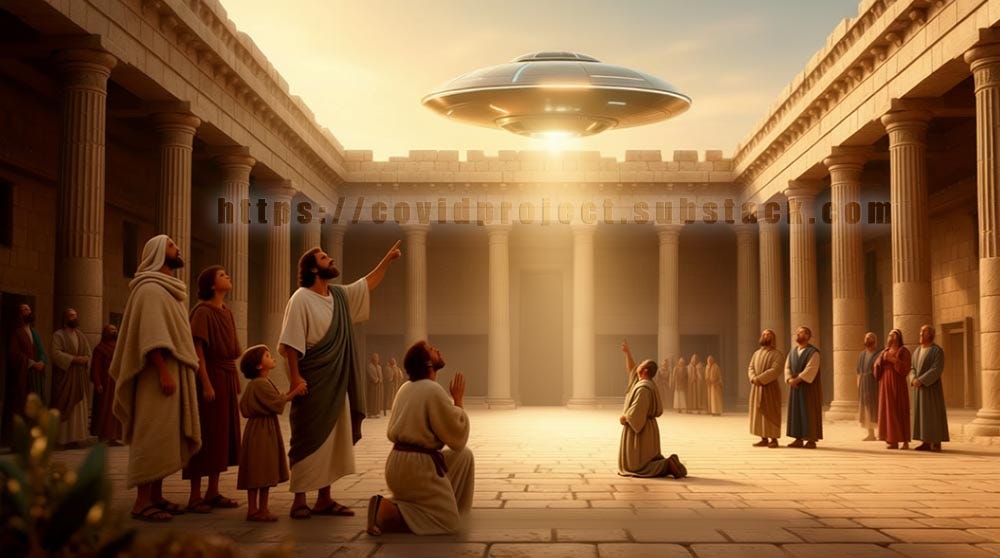
In Ezekiel 1, the kavod appears as a moving structure, surrounded by living creatures, wheels within wheels, fire, crystal, and vertical movement: “And I saw something like a form of a human over the throne… like the appearance of fire… and a radiance around.” Here, the kavod is not just light; it is architecture, mechanics, energy. It rises, moves, and stops. Ezekiel falls on his face as if before an overwhelming physical presence. The kavod is not merely a divine attribute but an entity with physical properties.
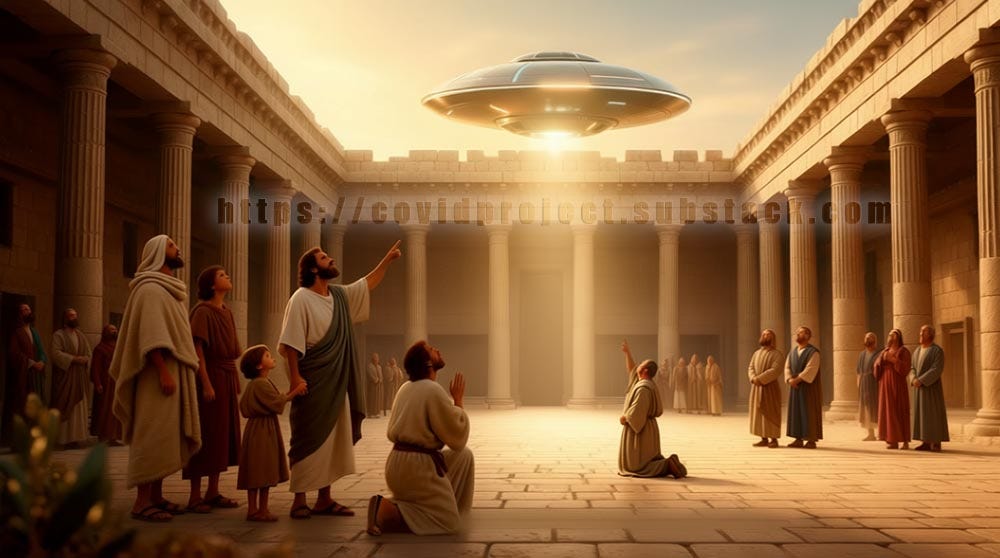
Ezekiel’s descriptions of the kavod detail it being “transported to different locations” within the “kavod,” feeling textures and hearing sounds, suggesting an experience aboard a physical craft rather than a spiritual vision. A “ship” or “heavy equipment” with “wheels within wheels,” a design that a NASA engineer patented in 1974 for Mars rovers. Dr. Jeff Banner, from the Ancient Hebrew Research Center, supports a concrete interpretation, proposing that the original meaning of kavod is “battle armament.”
Of course, all this should not be viewed through the filter of doctrinal theology; it is something deeper: phenomenological reasoning. It involves observing the texts with an alert mind, not accepting symbols as mere metaphors, but asking: What if this were real? What kind of reality would it be? All these questions sound absurd if we think that kavod only means glory.
Mauro and Paul’s video in English:
 | A guest post by
|
Thanks for the information, Mauro's video is great.
Yet another proof of the damage theology has wreaked on biblical texts, changing everything, interpreting everything, making people believe things that aren't real, camouflaging reality. Of course, the passages where the word kavod appears are much more understandable now. It was a physical object, and theology has hidden it all these centuries, making people believe it was a glory.
Excellent information. Moses didn't cross the Red Sea, and what he saw wasn't the Glory, but a flying object. It's crystal clear, Mauro's excellent analysis, asking certain questions that would be absurd to answer if we considered that was the Glory.