
Forbidden Archaeology (II)
Impossible Technology in the Stone Age: Evidence That Contradicts History


The conventional history of ancient Egypt, centered on the figure of Menes as the first pharaoh and unifier of Egypt around 3100 B.C., has been the narrative axis of Egyptology for centuries. However, a deeper look—supported by archaeological, geological, astronomical, and textual data—reveals a much more complex reality, suggesting the existence of an advanced civilization long before the traditional pharaonic dynasties.
It is within this context of mystery and doubt that a thousand theories have emerged regarding the builders of the impossible. Among those who have looked at those pyramids not just as historians, but as seekers of mysteries, the voice of renowned Spanish journalist and author J.J. Benítez is particularly prominent. In this article, we recover his words, a fascinating—and almost reverent—description of the Giza plateau and the three pyramids that defy time.
The Giza plateau stands as the supreme symbol of Egypt: Cheops, Khafre, and Menkaure. The Great Pyramid of Cheops is a challenge to reason: three million blocks of limestone and granite weighing between two and forty tons. Its precision is such that it does not allow the passage of a sheet of paper between blocks. Originally, it was clad with sixteen-ton polished limestone slabs. Beside it, Khafre occupies a base where seven soccer fields would fit, with 1,700,000 cubic meters of Tura stone and red granite from Aswan. Finally, Menkaure, though more modest, is equivalent to a twenty-story building.

Today, technology would have serious difficulties moving and placing those enormous stone blocks. Faced with such astonishing figures, the world wonders how they achieved it. For official archaeology, there is no doubt: the pyramids of Giza were built by order of the pharaohs. The blocks came from nearby quarries—Tura and Mokattam—and were placed using gigantic ramps, along which thousands of workers dragged them with wooden rollers.
The Logistical Impossibility: “Blocks Every Two Minutes”
Official archaeology dates these works to around 2500 B.C. They maintain that wooden ramps and rollers were used to move stones from the Tura and Mokattam quarries. However, this theory, popularized by archaeologist Ludwig Borchardt in the 20th century, collapses before arithmetic: if Cheops reigned for 23 years (2590-2567 B.C.), his workers had to place 357 blocks daily, with weights ranging between two thousand and forty thousand kilos. This means cutting, hoisting, and fitting a stone monster every two minutes for twelve hours a day. And that is without considering that, at that time, Egypt was barely emerging from the Neolithic: its inhabitants lived in mud-brick huts, used stone tools, and did not yet know writing or bronze metallurgy.
It should be noted that the Bronze Age did not reach Egypt until 2300 B.C., three centuries after the alleged construction of the pyramid. Recent studies by the Max Planck Institute have confirmed that the first copper alloys in the Nile date back to 3000 B.C., but they were not used for cutting hard rock like granite, but rather for ornamental objects.
[Note: We have been indoctrinated since childhood in such a way that we accept, without applying critical thinking, many historical facts that in reality are difficult or even impossible to sustain logically.]

But no matter how much labor Cheops gathered, the undertaking remains highly improbable, not only because of the logistical complexity but, above all, because of the enormous technical difficulties in hoisting and fitting those gigantic blocks of limestone, granite, and marble.
Questionable Historical Sources and Alternative Documents
The most conservative archaeologists defend themselves by hiding behind what was written by Herodotus in the 5th century B.C. Herodotus visited Egypt in 450 B.C., that is, 2,000 years after its alleged construction. His account is based solely on what local priests told him, without mentioning ramps or addressing the logistical problem of the 357 blocks per day. Therefore, his testimony lacks scientific value for reconstructing construction methods.
There is a second reason even deeper than the official chronology. If official archaeology dates this work to around 2500 B.C., when the Great Pyramid was supposedly built, the Nile Valley was barely entering the Neolithic. In Upper Egypt, the Fayum, and the western delta, communities lived in reed and mud-brick huts, used rudimentary lithic tools, and barely practiced incipient agriculture. The Bronze Age would not arrive until three centuries later, around 2300 B.C. An evident contradiction then arises: how could a Neolithic society, without metallurgy, writing, or advanced technology, erect a work of such precision and magnitude without the proper tools? Accepting that the Great Pyramid is the fruit of those conditions defies all historical logic.
The testimony of Herodotus is insufficient. Any current engineer recognizes the enormous technical difficulties involved in the Great Pyramid: its chambers, galleries, and conduits require advanced mathematical and architectural knowledge. It is enough to see the crude tools that, according to archaeologists, were used—and which did not even exist 4,600 years ago—to doubt this version.
How to explain the architectural perfection of the Great Pyramid? How to explain the incredible perfection of the angle of the casing blocks? Today we could only achieve it with optical instruments. Its faces are oriented North-South with a deviation of only 3 minutes and 20 seconds; its casing blocks—some weighing 16 tons—fit with such exactness that not even a sheet of paper can slide between them.
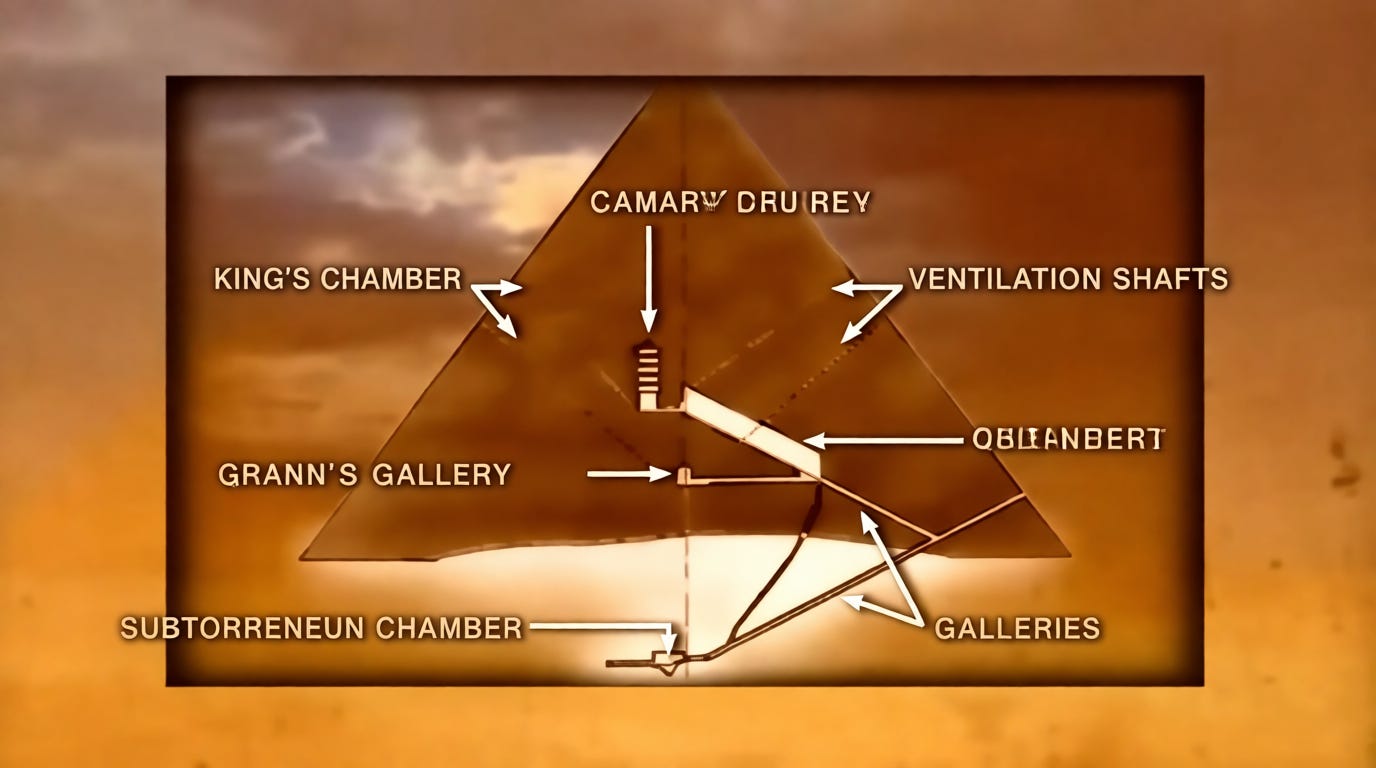
How to understand that four thousand six hundred years ago those Neolithic peoples already possessed a measurement as perfect as the cubit? As is known, only in the space age has it been possible to verify that the meter was mismeasured; its length is actually slightly more than what we had always believed. The exact meter has a length of 1.047. Well, two Egyptian cubits were exactly equal to 1.047: the meter of the space age. How did they achieve it?
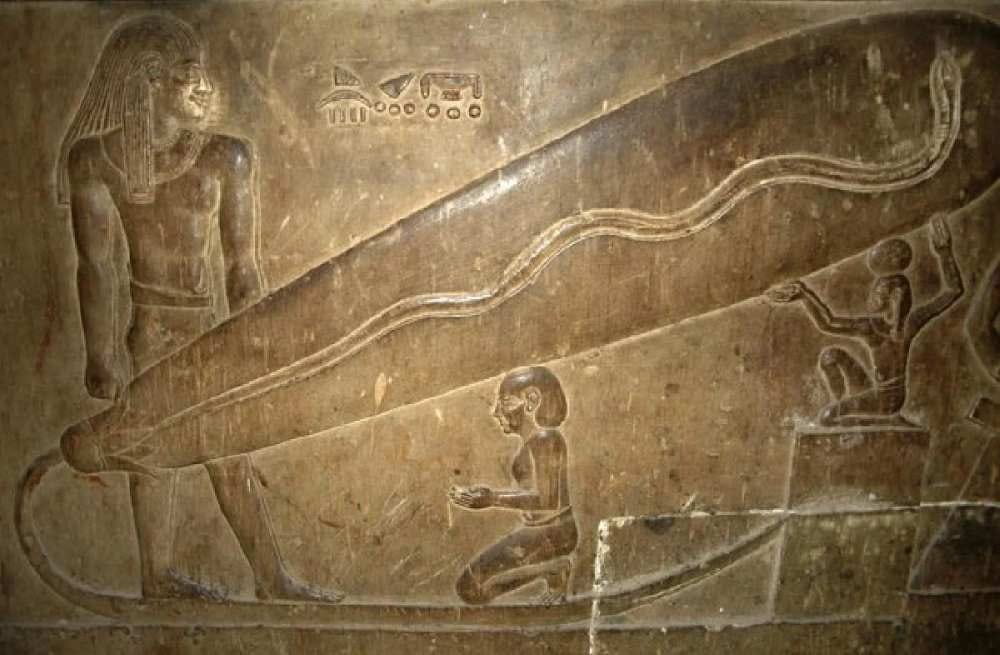
But the doubts and contradictions do not end here. To this day, no one has managed to satisfactorily explain the lighting system used when building the pyramids. There are no traces of soot on ceilings or walls, which rules out torches. And the theory of solar mirrors is technically unfeasible: the Sun moves, and maintaining a constant beam of light in narrow tunnels would be impossible without automated systems.
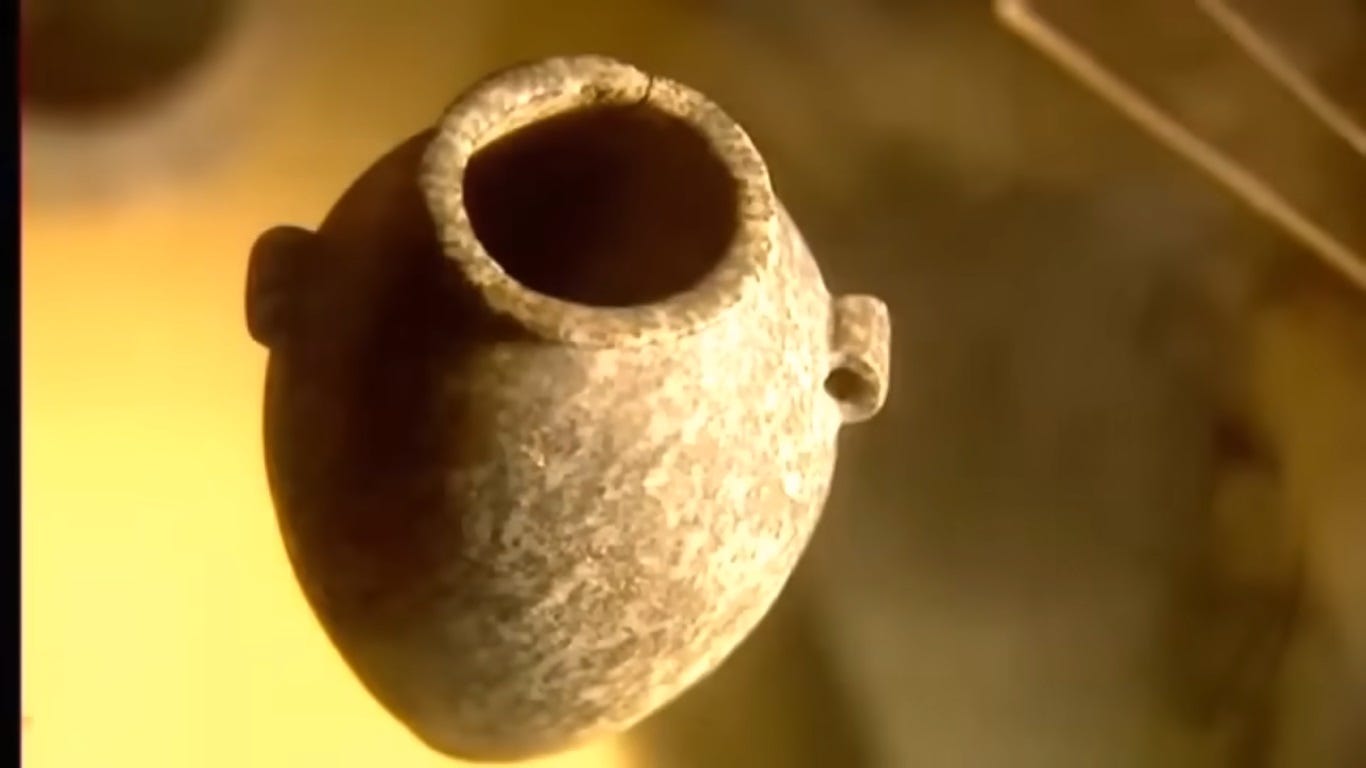
The explanations of archaeologists are also unconvincing when someone asks about the method used to cut the enormous granite blocks. Copper tools? That would be like trying to cut a marble table with scissors. The same applies to the surprising and enigmatic polishing of the diorite and granite vessels. What type of drill did they use so that the interior surface has the same shine as the exterior? How did they achieve this if even a child’s hand cannot pass through the openings of these vessels? And there is another striking aspect: when analyzing the polishing of these vessels and plates, experts have discovered that with each turn, the pressure applied was 500 times greater than what today’s powerful artificial diamond-tipped drills generate. And another great doubt arises: if many of these objects have been dated to approximately 2600 B.C., who manufactured them? Stone Age man? Clearly not.
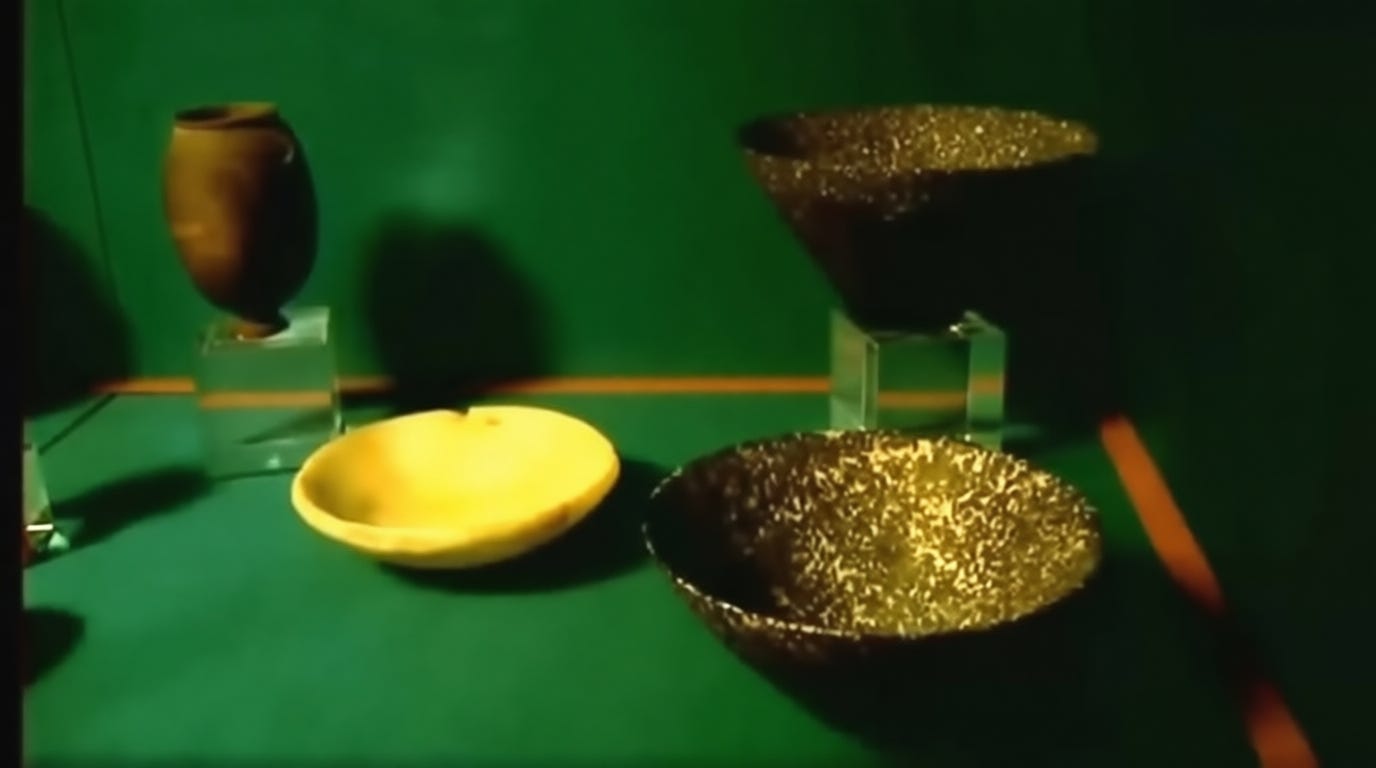
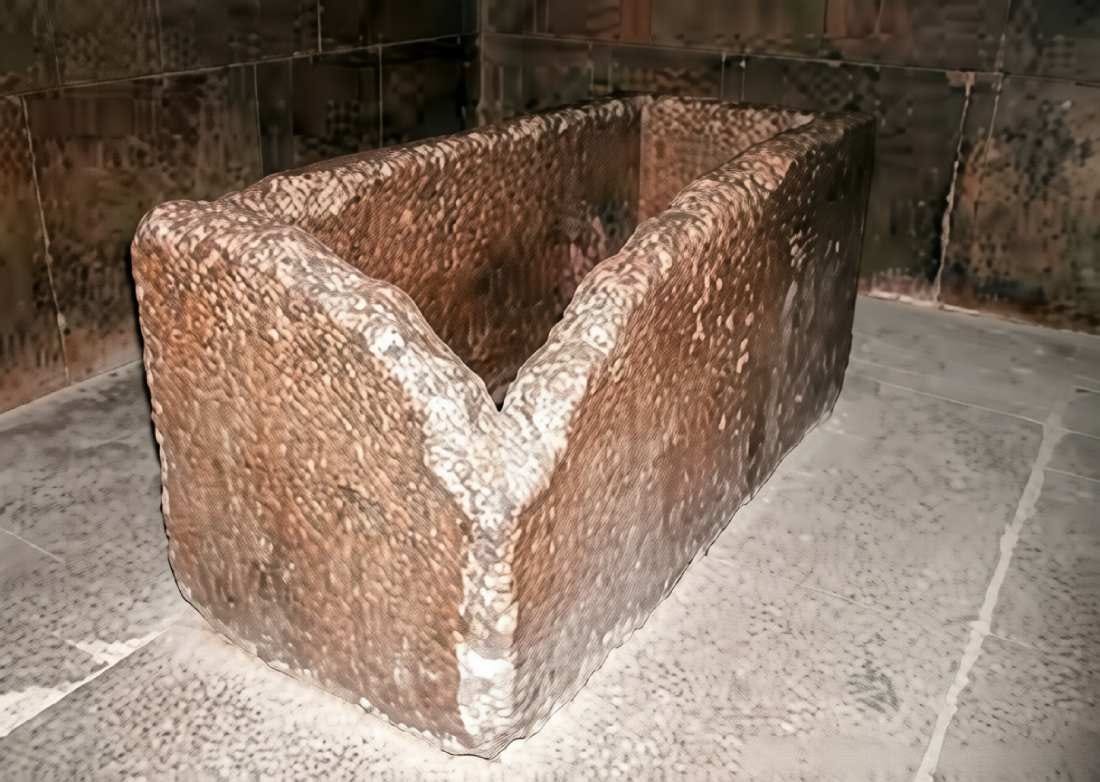
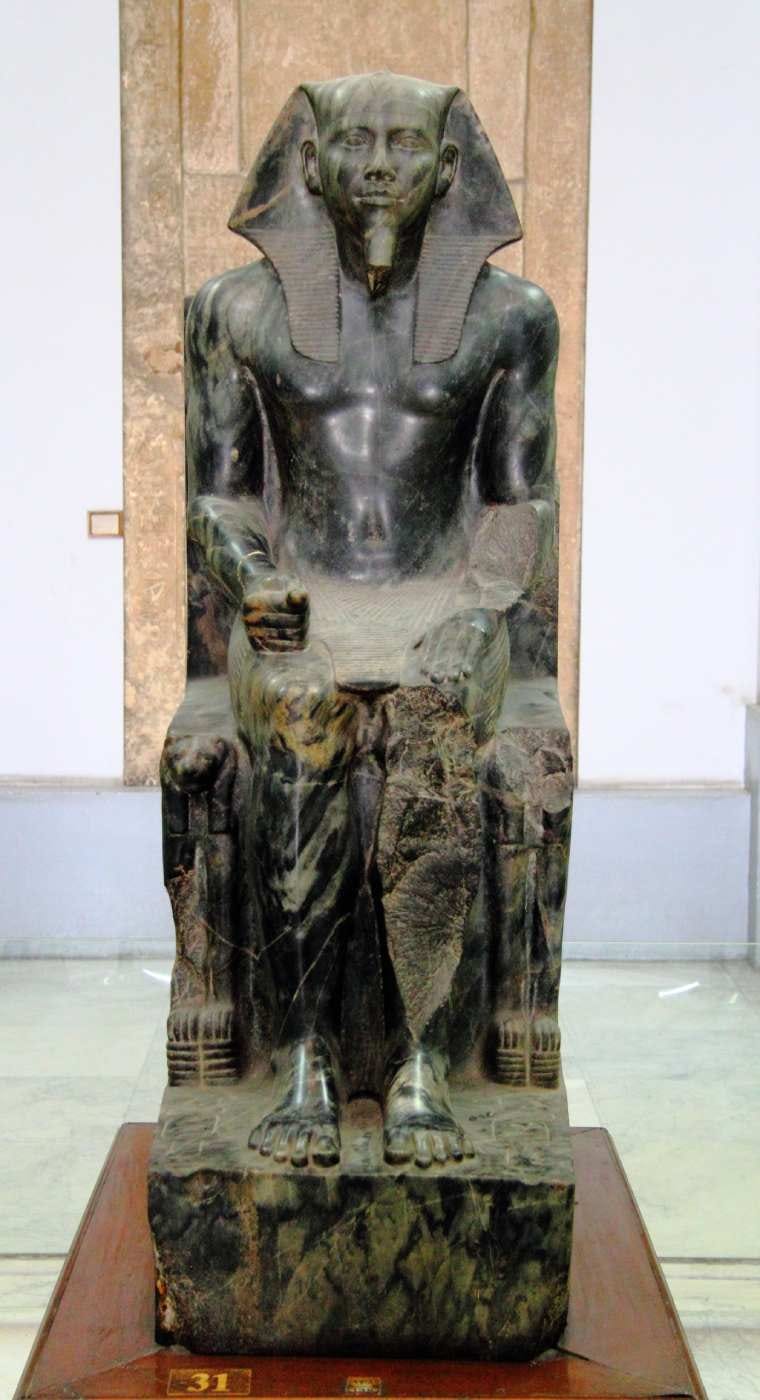
And all this, supposedly, with copper tools, mallets, and wooden rulers. Can anyone believe it? Worse still, there is more: the so-called “sarcophagus” of Cheops, carved in black granite, presents a surface with an imperfection of less than two ten-thousandths of an inch—one-tenth of the thickness of a human hair. The finish on the granite block is impossible for a Neolithic man. That perfection in working the hard black diorite reaches its maximum expression in the statue of the aforementioned Pharaoh Khafre, found in the Valley Temple next to the pyramid that bears his name. Its polish is such that only silence is appropriate. No one knows, no one understands how such beauty was achieved four thousand five hundred years ago.
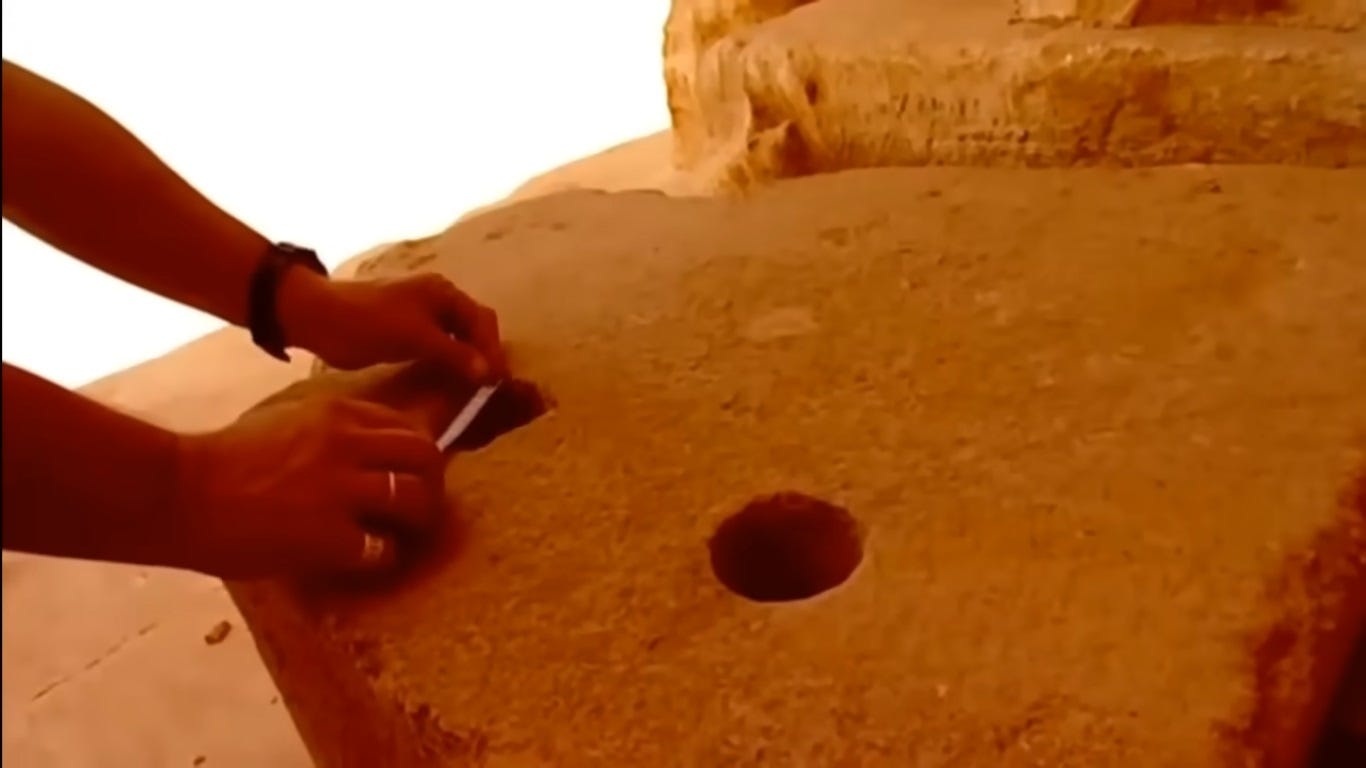
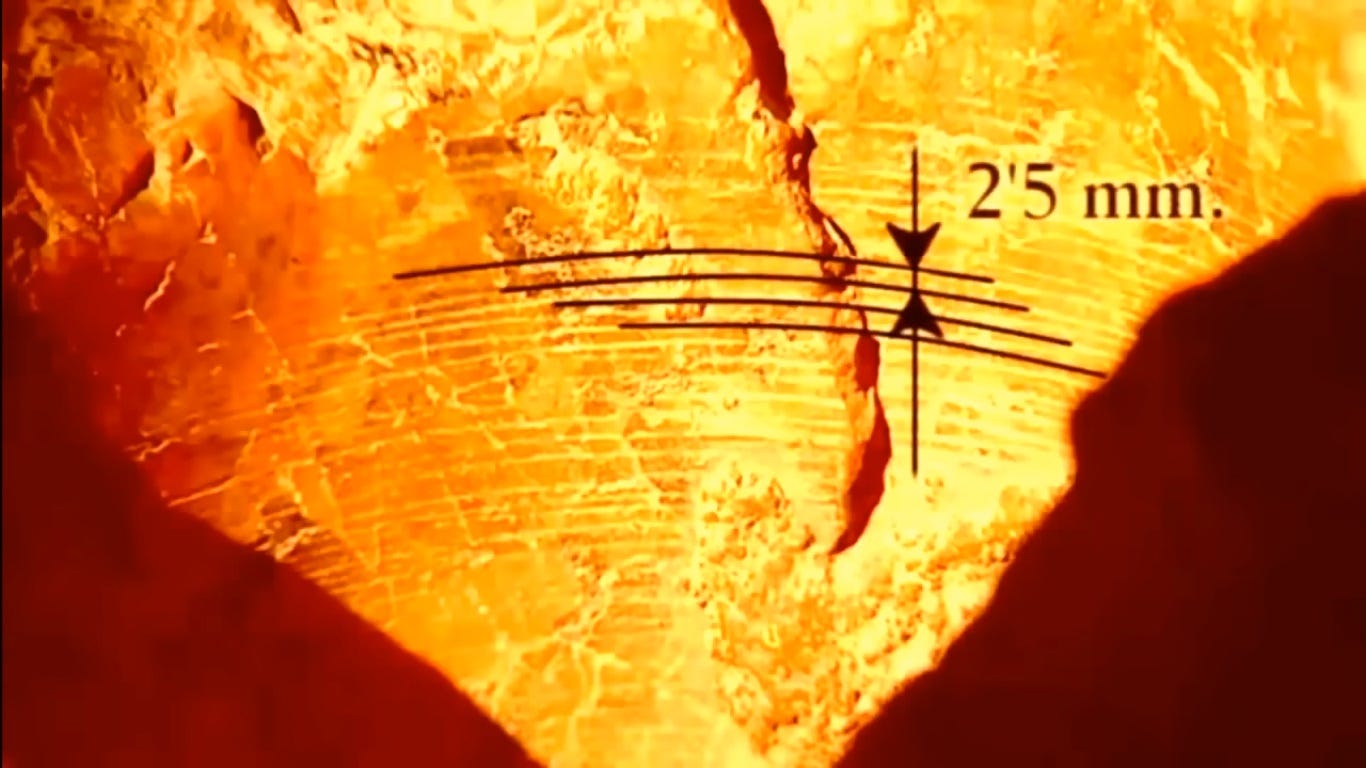
And how can the technique used to perform the drillings visible in numerous places in pharaonic Egypt be explained? One example is found at the main entrance of the Pyramid of Cheops. From an archaeological perspective, there is no mystery; it is believed that these holes were achieved by inserting a hollow cylinder into the stone, which, when rotated, cut the granite. However, when analyzing the spiral engraved inside, there are details that do not fit this official explanation. The distance between each line of the spiral is approximately 2.5 millimeters, while today, with drills equipped with artificial diamond tips, we can only achieve a progress of about 0.05 millimeters per turn. How did the ancient Egyptians, with tools as simple as a hollow cylinder, manage to apply such pressure and force to perform such precise drillings?
Today, frankly, very few believe in the official version. 4,600 years ago, the peoples inhabiting this region were not in a position to even imagine this architectural marvel. But then, who raised the pyramids? A first clue arises from a stela almost ignored by tourists, preserved in Room 42 of the Cairo Museum. Known as the “Inventory Stela,” it is probably a copy of a much older text. In it, a forceful phrase appears that challenges the official version: “Pharaoh Cheops founded the House of Isis, Mistress of the Pyramid, behind the House of the Sphinx, Mistress of the Pyramid.” Does this mean that the Great Pyramid and the Sphinx already existed when Cheops came to power?
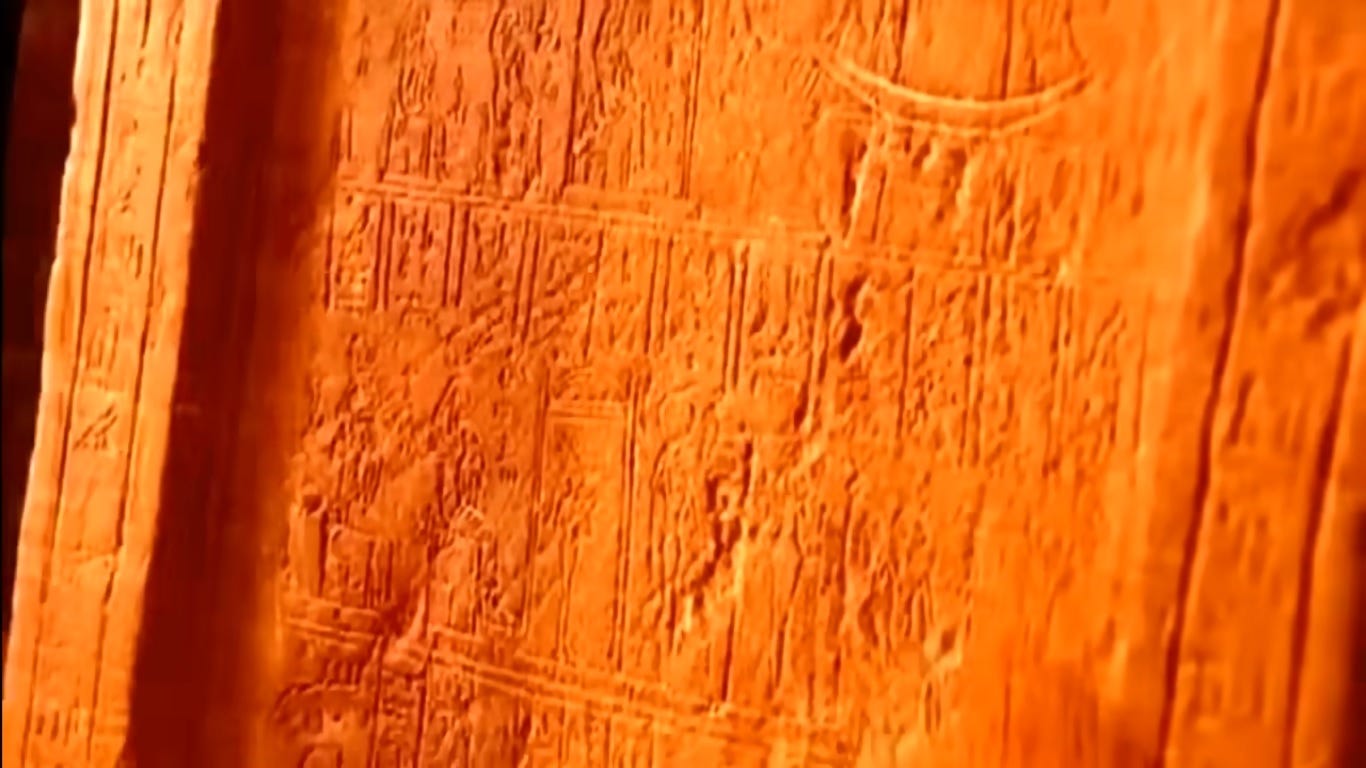
And the second clue, much more impressive, is found nearly three thousand kilometers from Cairo. It is a papyrus, or what remains of it, known as the Turin Papyrus. It was discovered in 1822 by the Italian traveler Bernardino Drovetti in the ancient Egyptian city of Thebes. Champollion himself translated it, giving it special relevance, although in the archaeological field, it has been generally ignored—and it is no wonder, given its content. This hieratic script dates back to the time of Ramesses, one of the most famous pharaohs, between the years 1290 and 1224 B.C. For some, Ramesses was the pharaoh who pursued Moses. In total, the papyrus consists of 160 fragments corresponding to 11 sheets, written about 3,200 years ago, in which a strange list of kings appears. It is a list of Egyptian kings that is impossible for science because, if what the document reveals is accepted, pharaonic chronology would completely collapse.
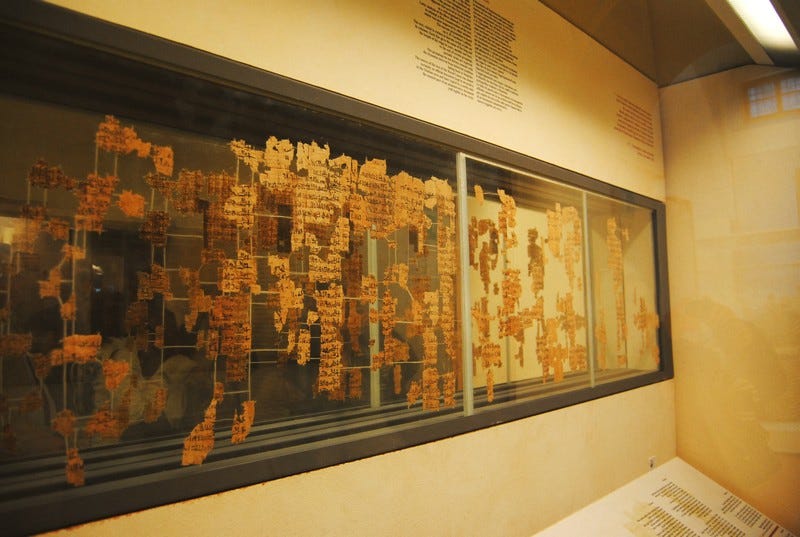
What does this papyrus, nearly 1.70 meters long, say? Basically, that in a remote past Egypt was ruled by beings half-human and half-god called the “Shemsu Hor”, the followers of Horus. The list of these kings places their first government in the Nile Valley about eleven thousand years ago, long before the five thousand years marked by archaeology with Pharaoh Menes.
This disconcerting and revolutionary list of kings is largely ratified by another history, equally dismissed by archaeologists. I refer to what was written by Manetho in 240 B.C. This high priest was commissioned by Pharaoh Ptolemy II Philadelphus to write the history of Egypt from its beginnings. Manetho had access to the documentation deposited in the Temple of On in Heliopolis and completed the task. In the few fragments of his work that are preserved, especially those compiled by Eusebius of Caesarea, something unusual can be read which, as I said, coincides fundamentally with what is related in the Turin Canon. According to Manetho, before Menes, the first pharaoh of the first dynasty, Egypt was ruled by semigods for thousands of years. The Greco-Egyptian high priest does not speak of the Shemsu Hor, but the coincidence is more than suspicious. Who were the Shemsu Hor? Why are they described as semigods?
For traditional archaeology, both the Shemsu Hor and the data transmitted by Manetho are nothing more than myths, and at first glance, that might seem logical. If there really were civilizations ruling Egypt eleven thousand years ago, why hasn’t the material evidence they should have left behind appeared? Or perhaps it exists? Could it be that archaeology does not want to see it? Anyone applying a minimum of logic would realize that archaeological arguments, both on this topic and many others, do not add up.
[Note: Given the existing physical evidence, it is reasonable to conclude that archaeology was created to cover up the truth, not to discover it.]
But perhaps the most striking proof comes from a seemingly insignificant object. The discovery is due to the Spanish researcher Manuel Delgado; he was the first to notice what the new Nubian museum holds. Quite a find, and one that once again makes us doubt the official chronology. We refer to an ostrich egg found in 1907 in Tomb 96 of Cemetery 102 in Nubia. Someone drew on it and placed it beside the corpse; evidently, it was an object very dear to the deceased. On one of the surfaces, drawings of an ostrich and some plants can be seen; on the opposite side, another impossible scene: the course of the Nile River and the silhouettes of some very familiar constructions—the three pyramids of the Giza plateau.
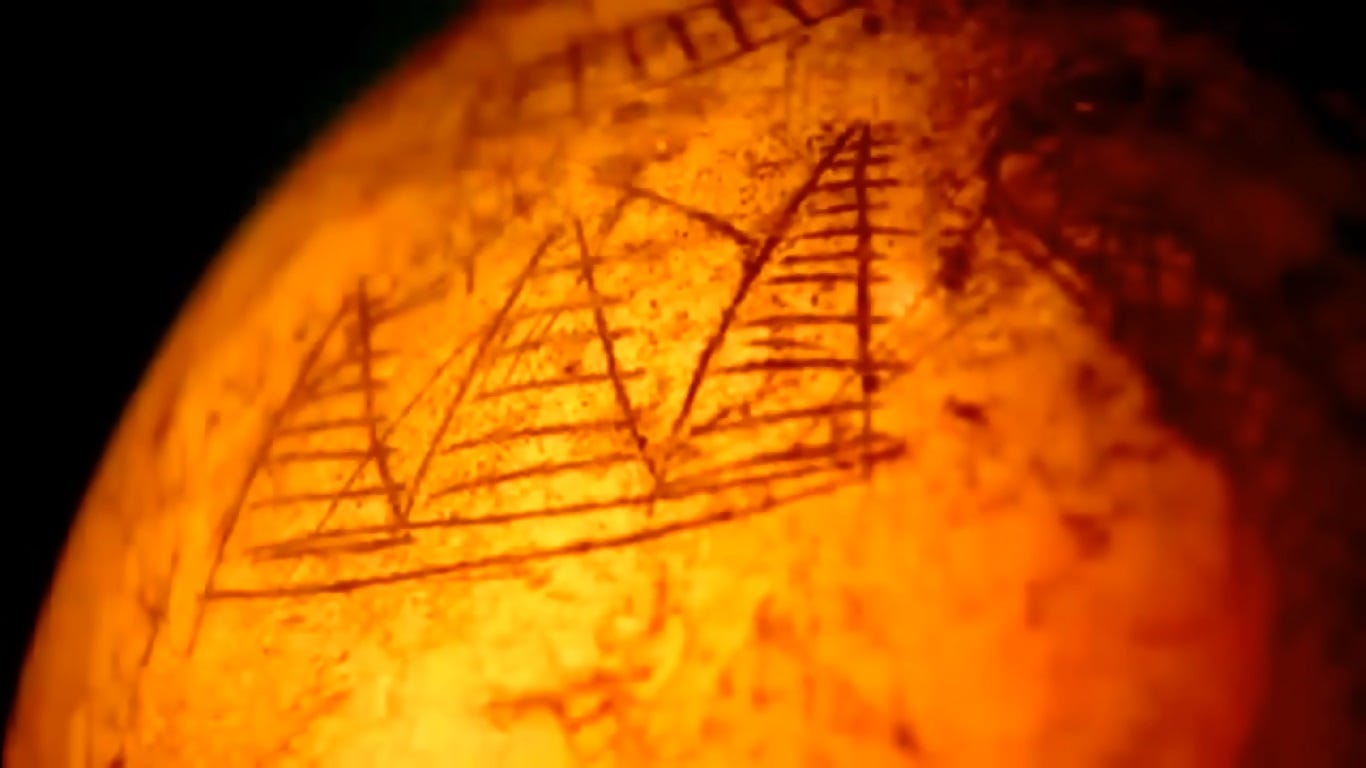
The finding of this ostrich egg would be of no great importance were it not for one small, major detail: according to researchers, the human remains in the aforementioned Tomb 96 date back to the Naqada I culture, that is, around 7,000 years ago. Something, indeed, does not add up. If archaeology claims that the Giza pyramids were raised 4,500 years ago, how is it that they appear drawn in a burial from 7,000 years ago?
The Sphinx is another emblematic monument of Egypt, built according to archaeology by Pharaoh Khafre 4,500 years ago. It was originally painted with a red body, a blue headdress with yellow stripes, a false beard, and a statue in front of it. During the Mamluk invasion, the Sphinx was shelled and its nose destroyed. Why does archaeology place the construction of the Sphinx in that era? Firstly, because of the resemblance of the face to some of the statues of Khafre, and also due to the fact that it is located very close to the funerary temple of said pharaoh. Although it seems incredible, that is all.
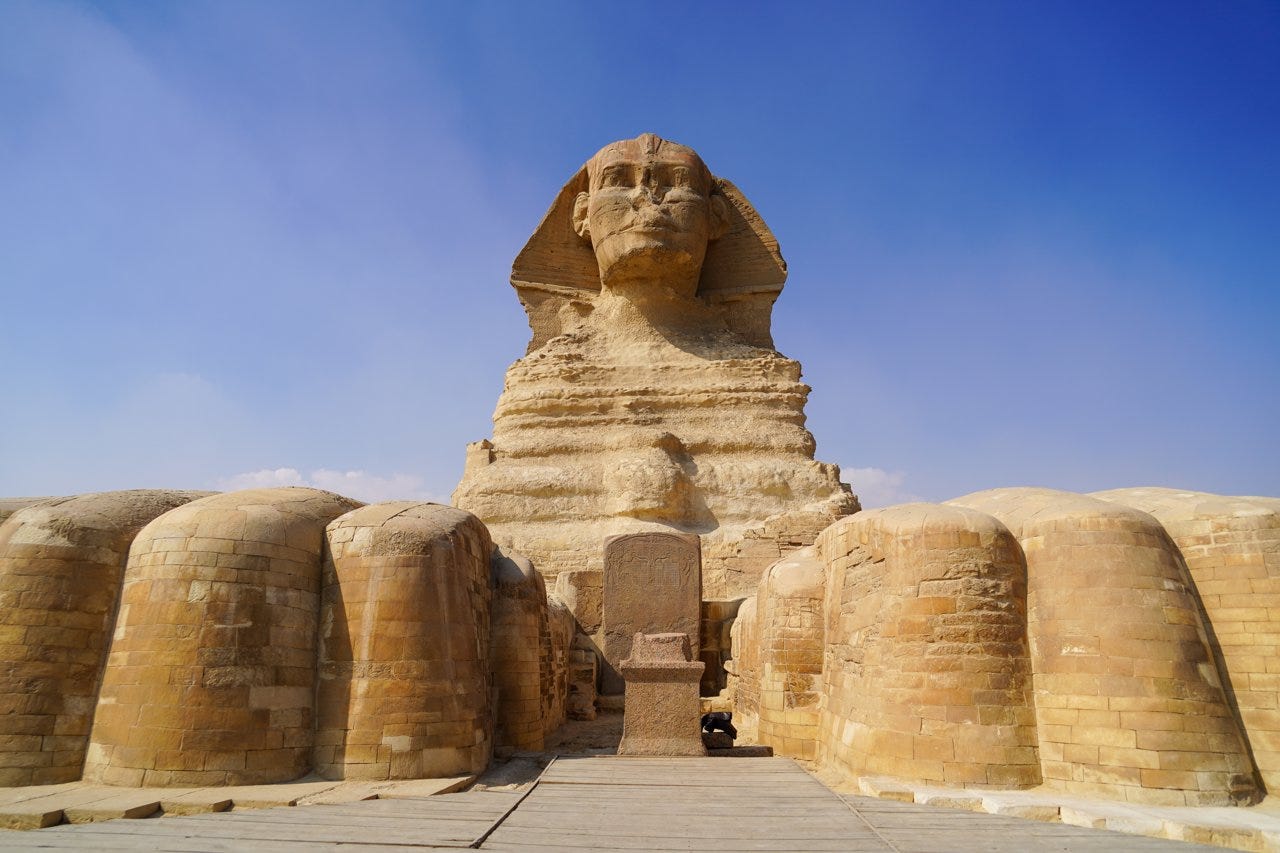
But the evidence pointing to a past much more remote than what Egyptology claims does not end here. Added to this is the geological analysis of the Sphinx. In 1991, a team from Boston University led by geologist Robert Schoch demonstrated that the two-meter-deep erosion on its body and on the walls of the ditch surrounding it was caused by torrential rains, not by wind or sand. In the time of Khafre, the supposed builder of the Sphinx, this region was a desert; the Sahara climate became arid around 3500 B.C. The only time there were sufficient rains to cause that erosion was between 7000 and 5000 B.C.—during the so-called Holocene Wet Phase. Therefore, the Sphinx is thousands of years older than Khafre, to whom its construction is attributed.
About 12,000 years ago, North Africa suffered a drastic climate change, confirmed by studies such as those from Boston University. The monsoons weakened 8,000 years ago, initiating the desertification of the Sahara. By the time the Sphinx was built—4,500 years ago, according to archaeology—the rains had already completely disappeared from the region. This suggests that Khafre could not have erected the Sphinx from scratch, but rather, at most, could have restored it. The evidence of the Holocene Wet Phase—with its intense rains—proves that this monument already existed long before, as a silent witness to a lost era.
Something similar happened with researcher Robert Bauval. This Egyptian engineer dared to spread a hypothesis that shocked followers and lovers of pharaonic Egypt. For Bauval, the Giza pyramids are not isolated constructions; the three are part of a meticulously designed unified plan. And to the irritation of the most conservative archaeologists, he formulated a theory that once again questioned the already discredited official chronology.
Bauval’s thesis is known as the “Orion Correlation,” that is, the astonishing resemblance in the layout of Cheops, Khafre, and Menkaure regarding the three stars that form Orion’s Belt. It is enough to draw a line between the three pyramids and another between the stars of the belt to observe that both locations are nearly identical. Nearly identical, yes, but not equal; the angle of the pyramids is 172 degrees and that of the stars of Orion today is 181. Bauval noticed this small difference and had a brilliant intuition. With the help of computers, he went back in history and discovered that the alignment of the stars in Orion’s Belt coincided with that of the pyramids 12,500 years ago.
Are there not too many coincidences? On one hand, geology proves that the Sphinx had to be built in the middle of the Great Wet Phase, that is, more than 9,000 years ago. On the other hand, the Turin Papyrus and Manetho assure that semigods ruled the Nile Valley 11,000 or 12,000 years ago, perhaps more. Also, the ostrich egg found in Tomb 96 in Nubia tells us that the pyramids already existed 7,000 years ago, and Bauval’s thesis provides the final point by insisting again on that mysterious date: 12,500 years. If three clues constitute proof, what can we think when at least five clues are counted?

The evidence contradicting official archaeology’s version has not concluded. This painting was discovered in the Algerian Tassili; according to archaeologists, it is approximately 5,500 years old, probably much more. It depicts an Egyptian chariot. But how is an Egyptian chariot possible 2,500 kilometers from the Nile? An Egyptian chariot before Egypt existed? If archaeology says the first pharaoh of the first dynasty began to reign 4,900 years before the present, how do we explain this painting dated much earlier?
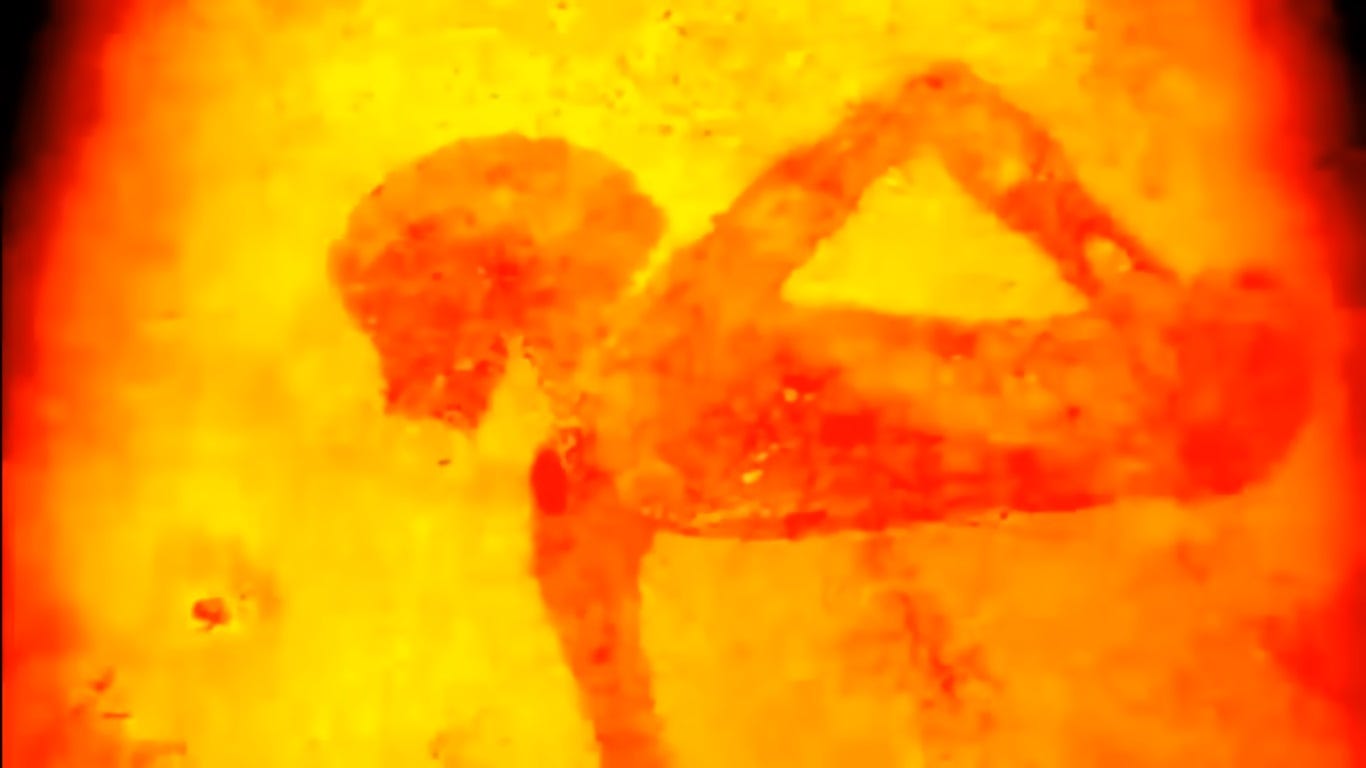
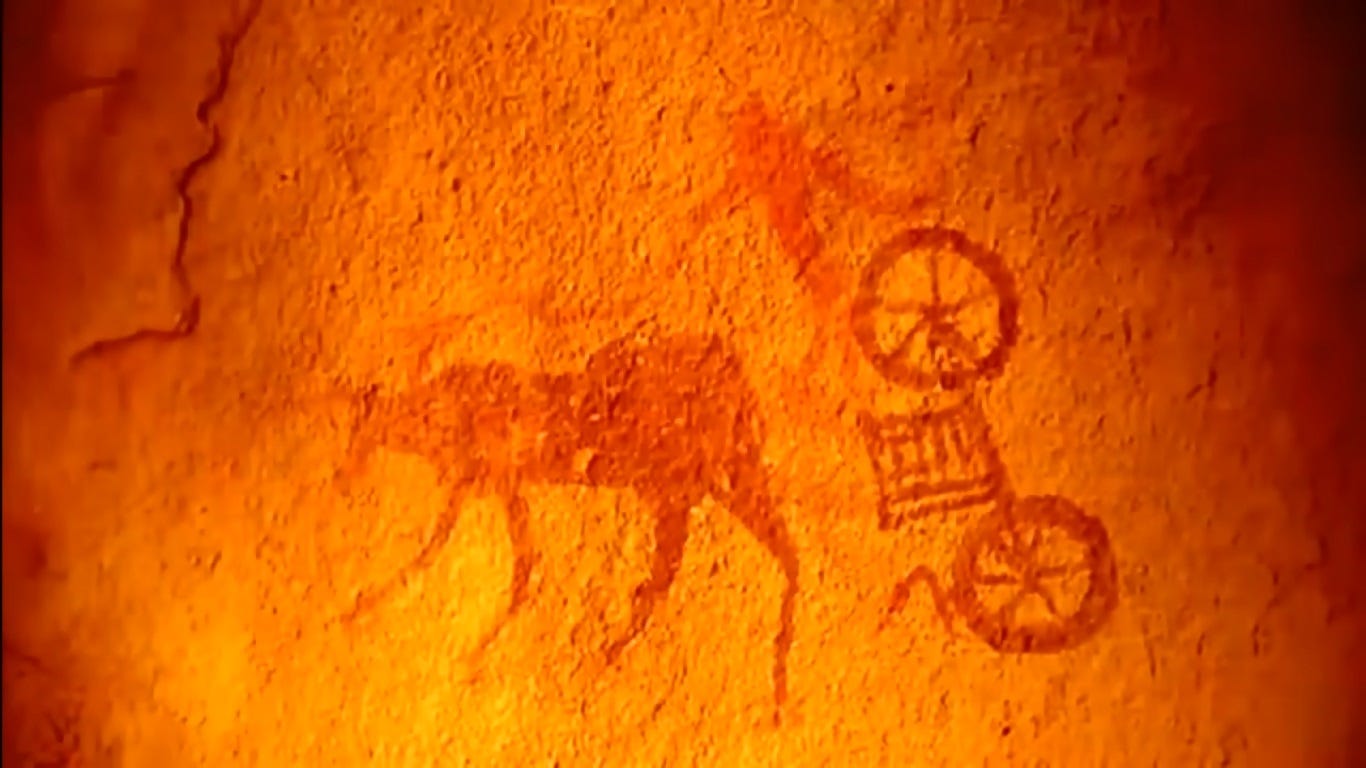
It was not the only one; in my investigations through the Sahara, I was able to discover hundreds of them. In 1982, a synthesis of Henri Lhote’s work brought to light a total of 600 painted or engraved chariots; to these must be added another 400 distributed through Mauritania, Morocco, Algeria, Libya, Mali, and Niger. More than 1,000 chariots painted or engraved two thousand, three thousand, and five thousand kilometers from the Nile. How strange: typically Egyptian chariots and drivers; profiles, headdresses, and garments are eloquent. Egyptian chariots and characters in the heart of the Sahara!
When I questioned the archaeologists, most shrugged their shoulders. Truth be told, these paintings are not comfortable. Some have been dated to an era when, according to archaeology, chariots and horses had not made an appearance in Egypt. Others, such as those from Tassili or the Fezzan in Libya, are much more scandalous.
The analyses of organic substances contained in the pigments have been disconcerting: 6,000, 8,000, and up to 9,000 years old. Egyptian chariots and drivers 9,000 years ago! And almost unintentionally, in view of these pictorial documents, memory brings back the findings of Boston University, the Turin Papyrus, the history told by Manetho, the pyramids painted on the ostrich egg, or Bauval’s discovery. Naturally, for archaeology, these paintings and engravings make no sense; horses and chariots, they say, entered Egypt around 1700 B.C. and did so with the invasion of the Hyksos, a people from Upper Syria who ruled the eastern half of the delta. Another new and serious error of archaeology. The horse and chariot, as these paintings and engravings demonstrate, already existed in the Sahara long before the thirteenth dynasty; another matter is that they do not want to admit it, and it is understandable. If the Egyptians and their culture originate from the Sahara, what remains of the supposed hegemony of pharaonic Egypt?
But the impossible Egyptian paintings in the Sahara 2,500 kilometers from the Nile are not limited to galloping chariots; others, to the bewilderment and irritation of archaeology, present very different scenes: offerings, characters adorned with the “uraeus” (the sacred serpent) on their heads, equally Egyptian boats, garments similar to those worn by pharaohs and priests, individuals in profile in the purest Egyptian style. All these paintings are much earlier than pharaonic Egypt.
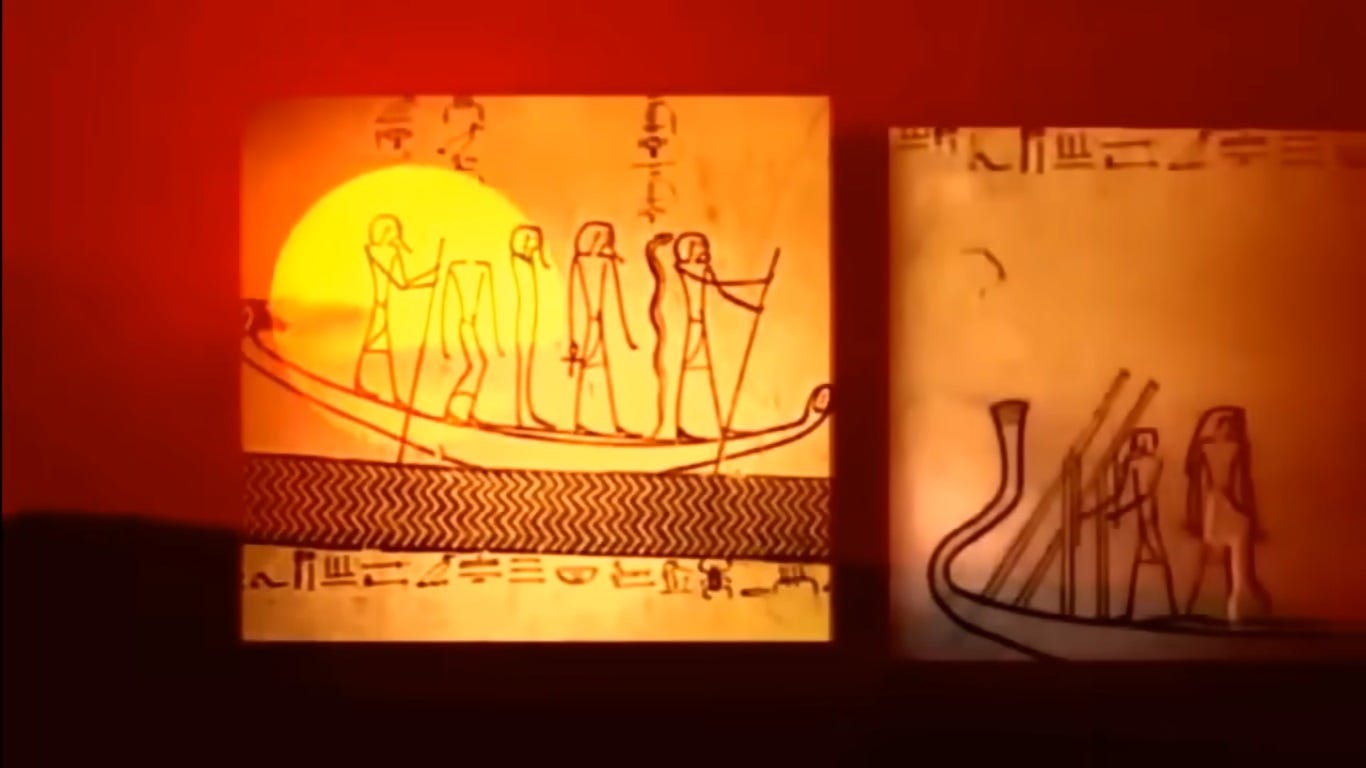
Egyptian boats in the middle of the desert! If these paintings, as the confused and muddled archaeologists claim, were merely testimony to the influence of the eighteenth dynasty in this remote part of the Sahara, what would be the point of them? At that time, 3,500 years ago, this area was a desert identical to the one we see now. Boats in a hell of stone and sand! And why do they ignore the dating? If these paintings date back 9,000 years, then the boats are justified; at that time, as will be remembered, the Sahara was a garden with rivers as wide and deep as the current Amazon.
But the strange coincidences go further. In this tomb, along more than 120, some 3,100 years ago, Ramesses III ordered the painting of what is known as the Book of Gates, a kind of cartography of the afterlife, a synthesis of the religion of the underworld, the religion of the infernal river. The religion that started from the Sahara and subsequently, with migrations, appeared among the Guanches, the Libyans, and the Etruscans. Coincidence?
And what of the hundreds of representations of the sacred cow Hathor, the bull Apis, or the ram Amun, all Egyptian, with the solar disk between their horns? How to explain that these same images can be found in the cave paintings and engravings of Morocco, Libya, or Algeria? Engravings and paintings, let us not forget, nine thousand, ten thousand, and twelve thousand years old; that is, much earlier than the known Egyptians. For those who want to see it, it is very clear: the sun god or Amun-Ra of the Egyptians, the Magec of the Guanches, or the Baal-Hammon of the Phoenicians have a common origin: the deep and forgotten Sahara.
Perhaps Herodotus and Diodorus Siculus were right: pharaonic Egypt was the work of the gods. The time has come to be brave: for me, 9,000 or 10,000 years ago, perhaps more, someone non-human descended into the great garden, into the blue Sahara, and set in motion a great culture, a civilization included in a common language, religion, and customs. Those beings, those round-headed gods painted in Tassili, could have come from Orion. And they or their descendants raised these magnificent and impossible constructions. Do you believe this is a fantasy? Schopenhauer said that all truth, when born, is ridiculed and persecuted. Let us give time to time. Someday, man will be forced to rewrite history once again.
 | A guest post by
|
I'm amazed at how people don't think; they want us to believe that some men eating garlic and without copper tools cut granite blocks weighing over 40 tons. Excellent article.
Magnificent article, everything you discuss is magnificent, and I agree with what you've been saying: our entire civilization is a lie, we've already seen it with science, religion, and now with history.